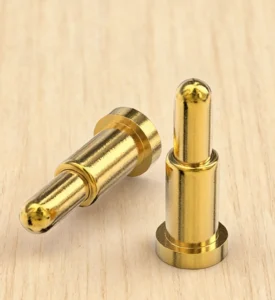
Removing a user-accessible USB or charging port does not automatically create a hermetically sealed device. A port-less product may still require wired access for production testing, programming, calibration, failure analysis or controlled service. In many architectures, replaceable pogo probes are installed in an external fixture and contact flat targets on the device. The sealing result depends on the complete enclosure, target feedthrough, joining process and leak-test criteria—not on the pogo pin alone.
Consumer, industrial and medical electronics may remove conventional user-accessible ports to simplify the exterior surface, control the accessory ecosystem or support a defined enclosure-protection strategy.Daily charging and data transfer may then use contactless power, wireless communication or a proprietary external accessory. However, manufacturing and service teams may still need deterministic electrical access to the product.
Possible requirements include:- Powering an unconfigured assembly
- Programming boot firmware
- Testing PCB interconnections
- Reading manufacturing diagnostics
- Calibrating sensors
- Testing radios, audio or power circuits
- Verifying enclosure sealing
- Recovering an approved serviceable fault state
A pogo pin interface may provide this temporary electrical access. The correct architecture depends on whether the contacts are external, concealed beneath a removable cover, accessible only after disassembly or used exclusively before final sealing.Port-Less, Sealed and Hermetic Are Different Terms
| Term | Engineering Meaning | What It Does Not Automatically Prove |
|---|---|---|
| Port-less | No conventional user-accessible charging or data receptacle | No seams, vents, speakers, microphones, buttons or service contacts |
| Flush-contact interface | Conductive target pads are integrated into an exterior surface | Hermeticity, corrosion resistance or safe exposed voltage |
| Sealed enclosure | An enclosure uses defined joints, adhesives, gaskets, welds or feedthroughs to limit ingress | A particular IP classification or allowable leak rate |
| IP-rated enclosure | The defined enclosure has been tested for specified ingress-protection conditions | Gas tightness, vacuum integrity or unlimited environmental resistance |
| Hermetic enclosure | A sealed boundary is evaluated against a defined gas-leak or sealing criterion | That every port-less consumer product is hermetic |
A product can be port-less without being hermetic. It can also contain external conductive targets while maintaining a defined water-resistant enclosure, provided the complete target-to-housing feedthrough has been designed and validated.
Choose the Test-Access Architecture Before Choosing the Pogo Pin
Several test-access structures are possible. They provide different sealing, security, service and manufacturing trade-offs.| Architecture | Interface Location | Primary Trade-Off |
|---|---|---|
| PCB test pads before final assembly | Accessible only on the open PCB or subassembly | No field access after the product is closed |
| Internal pads behind a removable cover | Accessible after opening the housing | The original seal is disturbed and must be replaced and revalidated |
| External flush targets | Visible or concealed on the exterior surface | Requires ESD, corrosion, short-circuit and unauthorized-access controls |
| Targets behind a sealed service door | Accessible after opening a dedicated service feature | The service door becomes part of the enclosure-protection boundary |
| Temporary contacts used before sealing | Removed or covered during final assembly | No electrical recovery path after final sealing |
| Permanent sealed electrical feedthrough | Conductors pass through a controlled enclosure boundary | Requires a validated joint between the conductor and housing |
| Contactless production interface | Wireless power, optical or radio access | Boot-state availability, speed, security and fixture complexity |
A product may use more than one architecture. For example, early PCB programming may use open-board test pads, while final functional testing uses external targets and a sealed-device fixture.Distinguish Device Targets from Fixture Pogo Pins
In a common production-test architecture, the spring-loaded contacts are installed in the manufacturing fixture rather than in the product.| Element | Typical Location | Primary Function |
|---|---|---|
| Pogo probe | Replaceable fixture or diagnostic jig | Provides compliant temporary contact |
| Target pad | Device PCB, FPC, metal insert or sealed feedthrough | Provides the opposing electrical surface |
| Probe receptacle | Fixture plate or probe block | Allows probe replacement and wiring |
| Mechanical nest | Production fixture | Locates and supports the device |
| Clamp or actuator | Production fixture | Controls final probe compression |
| Fixture controller | Test equipment | Controls power, programming, measurement and fault handling |
This structure prevents a permanent spring mechanism from consuming space inside the device and allows worn fixture probes to be replaced.

The target pads remain part of the product design and must still be reviewed for finish, sealing, ESD, contamination and electrical security.
Magnetic Docking Is Optional
Magnets may assist a manual service adapter or diagnostic accessory, but they are not required for every production fixture.Possible fixture-positioning methods include:
- Hard mechanical datums
- Locating pins
- Vacuum nests
- Pneumatic clamps
- Cam mechanisms
- Robotic grippers
- Vision-guided placement
- Magnetic capture
- A combination of these methods
Magnets can help pull two parts together but should not define the final probe compression.Excessive magnetic attraction may:
- Increase seating impact
- Over-compress the probes
- Attract conductive or ferromagnetic debris
- Change the device orientation before mechanical location
- Interact with Hall sensors, speakers or internal magnets
- Make controlled fixture removal more difficult
Mechanical datums and stops should establish the final test position.Define the Real Test and Debug Functions
A hidden contact array should be developed from a documented Pin Map rather than from a generic “JTAG connector” or “diagnostic port” label.| Possible Function | Engineering Questions |
|---|---|
| Fixture power | Can the device be powered before the battery or operating system is available? |
| Power return | What return path exists during every credible fixture state? |
| Reset | Which reset domain is controlled and what voltage level is required? |
| Boot-mode selection | Which strap or control state selects the intended recovery mode? |
| JTAG or boundary scan | Which TAP signals, voltage domain and access permissions apply? |
| SWD | Does the processor implement Serial Wire Debug and how is access controlled? |
| UART | Is the interface for logging, bootloader commands, manufacturing control or another function? |
| USB | Which USB generation, device role and physical-channel requirements apply? |
| I2C or SPI | Is the interface connected directly to sensors or routed through a test controller? |
| Analog measurement | Which voltage, current, thermistor or calibration nodes must be measured? |
| Fixture identification | Must the product authenticate or identify the connected fixture? |
| Ground or shield | How are signal return, chassis and transient-current paths separated? |
UART, JTAG, SWD, USB and sensor buses are different physical and protocol interfaces. Pin count alone does not determine which functions are available.JTAG Access Does Not Automatically Recover Every Device
A JTAG or another debug interface may support testing, programming, configuration or internal observation when the processor and security architecture permit it.Actual access may depend on:
- SoC debug architecture
- Boot ROM capabilities
- Secure-boot state
- Authentication keys
- Debug certificates
- Lifecycle state
- Security fuses
- Encrypted storage
- Battery or power-rail condition
- Hardware failure location
A device with damaged power management, memory, SoC hardware or internal interconnects may not be recoverable through a test pad.

The service architecture should therefore define which failures are recoverable, which require enclosure opening and which require board replacement.
Hidden Debug Pads Are Not Automatically Secure
Concealing a contact array can reduce casual access, but physical obscurity is not an access-control mechanism.Security controls may include:
- Disabling debug in production lifecycle states
- Authenticated debug sessions
- Cryptographic challenge and response
- Signed service tools
- Time-limited authorization
- Fixture identification
- Device-specific credentials
- Tamper detection
- Audit logging
- Restricted boot modes
The final design should balance manufacturing access, service needs, failure analysis and attack-surface reduction.Wireless Recovery Is Not Inherently Insecure or Too Slow
Wireless programming, calibration or diagnostics may be practical in some products. Its suitability depends on:- Whether the radio and firmware are already operational
- Authentication and encryption
- Image size
- Required production time
- Radio coexistence
- Fixture density
- Failure-recovery strategy
- Regulatory test state
A wired fixture can provide deterministic power, reset and low-level access when the wireless stack is unavailable. This does not make wireless manufacturing or service universally inferior.Develop the Production-Test State Sequence
| Fixture State | Mechanical Condition | Electrical Condition |
|---|---|---|
| Fixture empty | No device is present | Source probes remain in the defined safe state |
| Device loaded | The product enters the fixture nest | No valid electrical connection is assumed |
| Initial location | Datums or vision establish device position | The fixture may verify product presence |
| Probe approach | The actuator moves probes toward the targets | Source power remains controlled |
| Working stroke reached | Mechanical stops establish the test position | Continuity and fixture identity can be checked |
| Power enabled | The device remains clamped and supported | Current-limited fixture power is applied |
| Test or programming | The fixture position remains stable | Programming, calibration or measurement runs |
| Result verification | The device remains engaged | Checksums, measurements and test results are verified |
| Power removed | The fixture remains mechanically engaged | Defined rails and signals return to the safe state |
| Probe retraction | The probes leave the target surfaces | No powered separation occurs unless specifically validated |
| Device unloaded | The product is removed | The fixture prepares for the next cycle |
The Fixture Must Support the Product Mechanically
Pogo probes and target pads should not support the complete device load.A preferred load path is:
Device → Fixture Nest → Mechanical Frame → Machine Baserather than:
Device → Magnets → Pogo Probes → Receptacles → Fixture PCBFixture design should consider:
- Device mass
- Housing stiffness
- Display and camera protection
- Permitted clamp locations
- Adhesive and glass loading
- Target-pad support
- Robot placement variation
- Fixture wear
- Debris and cleaning
- Operator safety
Control the Probe Working Stroke
The test fixture must keep every probe inside its approved compression range.A simplified stroke calculation is:
S = Hfree - Htestwhere:
- S is the applied probe compression
- Hfree is the installed free probe height
- Htest is the final distance between the probe mounting plane and device target
The complete tolerance stack may include:
- Probe free height
- Probe receptacle position
- Fixture-plate thickness
- Actuator position
- Mechanical-stop tolerance
- Device housing dimensions
- Target-pad height
- Target flatness
- Fixture-nest wear
- Robot placement error
- Product deformation under clamping
- Contamination between the product and fixture
| Compression Condition | Possible Result |
|---|---|
| Below the approved minimum | Intermittent programming, unstable measurements or false failures |
| Within the approved range | Intended probe force and electrical contact |
| Above the approved maximum | Probe damage, target indentation, fixture-board load or product deformation |
| Unequal compression | Different contact resistance and unreliable multi-signal testing |
The final position should be set by a mechanical stop, not by magnetic attraction or actuator force alone.Target Pads Must Be Designed for the Complete Alignment Envelope
A target pad should remain reachable across all product and fixture tolerances.Define:
- Target length and width
- Target finish
- Flatness
- Position tolerance
- Surrounding insulation
- Mechanical support
- Permitted wear area
- Probe-tip geometry
- Maximum lateral offset
- Maximum angular error
A simplified usable-target condition is:
    Target usable width ≥ Probe contact width +
    2 × maximum lateral offset + wear margin


A power probe should not be able to reach an adjacent signal pad, opposite-polarity target or exposed housing metal during partial engagement.
Factory Cycle Life Is a Fixture-Maintenance Requirement
Production probes are consumable mechanical components. Their useful life depends on:- Probe construction
- Working stroke
- Tip geometry
- Target material and finish
- Cycle rate
- Electrical current
- Side load
- Contamination
- Cleaning process
- Fixture alignment
- Failure criterion
The production plan should define:- Probe inspection interval
- Cleaning interval
- Preventive replacement interval
- Contact-resistance monitoring
- Fixture self-test
- Golden-unit verification
- Failed-probe identification
- Spare-probe and receptacle strategy
A fixture should not depend on an unqualified “millions of cycles” statement.External Test Contacts Require Electrical Protection
External targets may be touched by users or exposed to conductive objects.Possible risks include:
- Electrostatic discharge
- Short circuits
- Moisture bridging
- Corrosion
- Unauthorized debug access
- Incorrect service adapters
- Foreign-object contact
- Reverse voltage
- Overvoltage from a damaged fixture
Possible controls include:
- Normally high-impedance target states
- Current limiting
- Series resistance
- Transient protection
- Fixture authentication
- Power enable after valid detection
- Recessed target geometry
- Asymmetric contact layouts
- Mechanical coding
- Firmware and lifecycle-state restrictions
A Sealed Feedthrough Is Part of the Enclosure Boundary
When a conductive target passes through the external housing, the target-to-housing joint becomes part of the sealing structure.Possible constructions include:
- Insert-molded metal targets
- Glass-to-metal feedthroughs
- Ceramic-to-metal feedthroughs
- Laser-welded metal inserts
- Adhesively bonded target inserts
- Overmolded flex circuits
- Targets mounted behind a continuous nonconductive window
Each structure creates different mechanical, thermal, electrical and sealing requirements.| Feedthrough Element | Required Review |
|---|---|
| Conductive target | Material, finish, thermal expansion and internal termination |
| Housing material | Glass, ceramic, polymer or metal compatibility |
| Joining process | Welding, brazing, molding, adhesive or another process |
| Bond-line geometry | Length, thickness, voids and leakage path |
| Thermal cycling | Differential expansion and joint fatigue |
| Mechanical loading | Probe force, impact, housing flex and target movement |
| Electrical isolation | Spacing, leakage, transient voltage and surrounding metal |
| Environmental exposure | Water, humidity, chemicals, sweat or cleaning agents |
Hermeticity Requires a Defined Leak Criterion
A statement that an enclosure is hermetic should identify:- The sealed volume
- The test method
- The tracer gas or pressure medium
- The test pressure
- The test duration
- The allowable leak rate
- The temperature condition
- The sample preparation
- The acceptance criteria
- The relationship to product ageing
Depending on the product and standard, sealing evaluation may include gross-leak or fine-leak methods.

Adhesive-bonded consumer enclosures are often described more accurately through water-resistance, ingress-protection or product-specific leak-rate requirements rather than a general “true hermetic” claim.
Pogo Pins Do Not Perform the Leak Test by Themselves
Test contacts may power the device, operate a valve, read a pressure sensor or communicate with the test controller during enclosure verification.

The actual sealing measurement may use:- Pressure decay
- Vacuum decay
- Differential-pressure measurement
- Tracer-gas detection
- Gross-leak testing
- Fine-leak testing
- Product-specific internal pressure sensing
An internal barometric sensor can only support airtightness verification when the complete method, calibration, sensor accuracy, internal volume, temperature and acceptance limits have been defined.

The Pogo Pin provides the temporary electrical path used by the test system. It is not the leak sensor or sealing mechanism.
IP Ratings and Hermetic Leak Testing Are Different
| Evaluation | Primary Question | Typical Output |
|---|---|---|
| IP enclosure test | Does the enclosure provide the defined protection against solids, water or access? | An applicable IP classification |
| Gross-leak test | Is there a relatively large leakage path through the sealed boundary? | Pass, fail or measured leakage result |
| Fine-leak test | Does the sealed boundary meet a defined small-gas-leak criterion? | Measured or equivalent leak rate |
| Production pressure-decay test | Does the assembled product remain within its manufacturing leak limit? | Pressure change over a defined period |
| Environmental ageing | Does the seal remain functional after temperature, vibration, pressure or chemical exposure? | Post-conditioning functional and sealing results |
Passing one evaluation does not automatically establish every other sealing or environmental claim.Do Not Use IP69K as a Generic Smartphone Claim
IP terminology should be tied to the actual applicable standard, equipment category and test procedure.

IEC 60529 provides the general enclosure IP classification framework. ISO 20653 applies specifically to electrical equipment in road vehicles.

A consumer device should not be described as IP69K simply because it has no USB receptacle or uses flush contacts.

Any high-pressure or high-temperature water-jet claim must identify:- The applicable standard
- The tested complete product
- The product operating state
- The mounting condition
- The test temperature and pressure
- The acceptance criteria
Opening a Device Normally Disturbs the Original Seal
Internal test pads located beneath rear glass or a bonded housing are not externally accessible.

Reaching them may require:- Heating the adhesive
- Separating glass or a rear cover
- Removing seals
- Disconnecting internal cables
- Replacing adhesive or gaskets
- Reassembling the enclosure
- Repeating the required leak or ingress test
A hidden internal contact cannot be claimed to preserve the original factory water-resistance rating when the enclosure must be opened to reach it.

An externally accessible sealed target array may allow some diagnostics without opening the device, but only for failures supported by the service architecture.
High-Speed Data Requires Complete Channel Validation
A sub-millimeter pogo probe does not automatically support USB 3.x or another high-speed interface.The complete channel may include:
- Test controller
- Fixture PCB
- Probe receptacle
- Pogo probe
- Contact interface
- Device target
- Device PCB or FPC
- Protection components
- SoC or PHY
High-speed validation may require review of:
- Differential impedance
- Insertion loss
- Return loss
- Near-end and far-end crosstalk
- Skew
- Mode conversion
- Reference-path continuity
- Fixture de-embedding
- Receiver and transmitter compliance
- Protocol enumeration
- Interoperability
Probe diameter, target size and DC contact resistance do not independently establish USB 3.x performance.Low-Speed Debug and High-Speed Data May Need Different Interfaces
| Interface Type | Primary Design Focus |
|---|---|
| Power and reset | Current capacity, sequencing, voltage drop and protection |
| UART | Logic levels, baud rate, ground reference and boot-state availability |
| JTAG or SWD | Signal integrity, access control, voltage domain and state sequencing |
| I2C or SPI | Bus voltage, pull-ups, loading, topology and direct-device access |
| USB 2.0 | Differential channel, return environment, ESD and compliance |
| USB 3.x | SuperSpeed channel loss, impedance, crosstalk, fixtures and interoperability |
| Analog calibration | Probe resistance, guarding, noise, offset and measurement uncertainty |
A compact array may use separate contacts for power, low-speed debug and high-speed programming, or the project may choose independent fixtures for different stages.Production Test Time Depends on More Than Docking
Total station cycle time may include:- Device loading
- Mechanical location
- Probe actuation
- Continuity check
- Power sequencing
- Boot time
- Programming time
- Calibration time
- Functional testing
- Result upload
- Power-down
- Probe retraction
- Device unloading
Magnetic capture may reduce part of the manual positioning time in a suitable fixture. It does not ensure that an operating-system image can be flashed in seconds or that the complete station is faster than a USB-based fixture.When May a Pogo Pin Test Interface Be Appropriate?
| Project Requirement | Possible Value |
|---|---|
| Programming before final enclosure sealing | Provides direct temporary access to the PCB |
| Automated production testing | Replaceable probes can contact a defined array repeatedly |
| Sensor calibration | Fixture contacts can provide deterministic power and communication |
| Leak-test control | The fixture can power or communicate with the product during sealing verification |
| External service interface | Sealed targets may support approved diagnostics without opening the enclosure |
| No permanent product receptacle | The moving probe mechanism remains in the fixture |
| High fixture maintainability | Individual probes can be inspected and replaced |
When May Another Architecture Be More Appropriate?
Another solution may be preferable when the product requires:
- No external conductive surfaces
- No physical debug path after production
- Very high-speed standardized data without a custom fixture channel
- Remote service without specialized hardware
- A truly hermetic glass, ceramic or metal package with qualified feedthroughs
- No permanent debug attack surface
- Consumer access to widely available cables
- Contactless testing through RF, optical or inductive methods
Recommended Validation Plan
| Requirement | Possible Evaluation |
|---|---|
| Test-access architecture | Open-board, internal, external, service-cover or feedthrough interface review |
| Pin Map | Power, reset, boot, debug, communication and measurement functions |
| Security lifecycle | Development, manufacturing, service and end-of-life access states |
| Mechanical location | Datums, clamps, magnets, vision and fixture repeatability |
| Probe working stroke | Minimum, nominal and maximum compression |
| Target alignment | Lateral, angular and height-tolerance envelope |
| Fixture load path | Product support without loading probes, glass or unsupported PCB areas |
| Contact resistance | Defined current, stroke, target finish and probe condition |
| Power path | Voltage drop, inrush, current limiting and temperature rise |
| Short circuit | Offset fixture, bridged targets and incorrect adapter |
| ESD | External targets, surrounding enclosure and service-adapter states |
| Programming reliability | Checksum, interrupted programming and recovery behaviour |
| Debug access | Authentication, locked states, fuse states and unauthorized fixtures |
| High-speed channel | S-parameters, eye performance, protocol compliance and interoperability |
| Fixture endurance | Project-defined cycles with probe wear and resistance monitoring |
| Fixture contamination | Dust, flux, oils, metal debris and cleaning intervals |
| Target wear | Surface inspection and electrical performance after repeated testing |
| Feedthrough sealing | Joint construction, thermal ageing, mechanical loading and leak testing |
| Gross and fine leaks | Applicable sealing method and defined acceptance criterion |
| Ingress protection | Complete enclosure under the applicable product test |
| Service reassembly | Seal replacement and post-service leak or ingress verification |
| Production variation | Fixture, target, feedthrough and assembled-device process capability |
Information Required for an Engineering Review
| Requirement Group | Information to Provide |
|---|---|
| Device type | Phone, wearable, industrial terminal, medical device or another sealed product |
| Interface stage | PCB test, final assembly, leak test, service or failure analysis |
| Contact location | External, internal, under a cover, behind glass or before final sealing |
| Pin Map | Power, return, reset, boot, JTAG, SWD, UART, USB and sensor functions |
| Electrical conditions | Voltage, current, logic levels, speed and permitted voltage drop |
| Debug architecture | SoC interfaces, boot states, security fuses and authentication requirements |
| Fixture geometry | Loading direction, mechanical datums, clamps, stops and automation method |
| Target geometry | Dimensions, pitch, flatness, material, finish and surrounding insulation |
| Probe requirements | Tip geometry, stroke, force, current, bandwidth and replacement strategy |
| Magnetic behaviour | Whether magnets are required, force, polarity and restricted regions |
| Sealing architecture | Insert molding, glass, ceramic, welding, adhesive, gasket or another process |
| Leak requirement | Test method, pressure, duration, allowable leak rate and acceptance criteria |
| Ingress requirement | Applicable IP or product-specific environmental condition |
| Service strategy | External diagnostics, enclosure opening, resealing and post-service verification |
| Production target | Units per hour, cycle time, station count and fixture maintenance interval |
| Files | 2D drawings, 3D models, PCB layout, schematic, fixture model and seal stack |
| Commercial | Prototype quantity, expected station count and production volume |
Common Engineering Mistakes
| Mistake | Possible Consequence | Better Approach |
|---|---|---|
| Calling every port-less device hermetic | No leak-rate or sealing criterion is defined | Use the applicable enclosure, IP or leak-test terminology |
| Claiming pogo pins create hermetic sealing | The actual feedthrough and housing joint are ignored | Validate the complete sealed boundary |
| Installing permanent pogo pins when fixture probes are sufficient | Product space, cost and sealing complexity increase | Place replaceable probes in the external fixture where practical |
| Using magnets as the final locator | Uneven probe compression and unstable testing | Use mechanical datums and stops |
| Calling hidden pads secure | Physical debug access remains exploitable | Use lifecycle and cryptographic access controls |
| Assuming JTAG can recover every bricked device | Security, power or hardware failures prevent access | Define the supported recovery states |
| Calling wireless testing inherently insecure | Authentication and architecture are ignored | Compare actual security and production requirements |
| Claiming magnetic docking supports faster production | Programming and test time dominate the station cycle | Measure the complete manufacturing cycle |
| Publishing millions of cycles without fixture conditions | Probe stroke, target and maintenance are omitted | Define the tested probe system and replacement interval |
| Calling internal pads externally serviceable | The enclosure must still be opened | Separate internal repair access from external diagnostics |
| Claiming repair preserves factory sealing | Adhesives and gaskets are disturbed during disassembly | Reseal and repeat the required enclosure test |
| Assigning USB 3.x capability by probe diameter | The complete high-speed channel remains unvalidated | Perform electrical compliance and interoperability testing |
| Using an internal barometer as universal proof of airtightness | Sensor error, volume and temperature effects are ignored | Define and correlate the complete leak-test method |
| Publishing IP69K for a consumer device without a standard basis | The equipment category and test procedure may not apply | Identify the applicable standard and tested product |
Engineering Reference Sources
The final standards, editions, product category and acceptance criteria should be confirmed for the actual enclosure and intended market.-
IEEE 1149.1 Working Group — Test Access Port and boundary-scan architecture
-
IEEE P1149.1 — Test, programming, configuration and debug access
-
Arm — Example JTAG and Serial Wire Debug signal definitions
-
IEC 60068-2-17:2023 — Gross- and fine-leak sealing tests
-
IEC 60529 — Degrees of protection provided by enclosures
-
ISO 20653:2023 — IP protection for road-vehicle electrical equipment
-
USB-IF — USB 3.2 electrical and interoperability compliance resources
-
USB-IF — Electrical compliance and connector test specifications
-
IEC 60512-2-2 — Contact resistance measurement
-
IEC 60512-9-1 — Mechanical-operation endurance without electrical load
-
IEC 60512-9-3 — Mechanical operation with electrical load
Frequently Asked Questions
Does removing USB-C make a device hermetically sealed?
No. Removing one receptacle may simplify part of the enclosure, but hermeticity requires a defined sealed boundary, leak criterion and test method.Do pogo pins create the enclosure seal?
No. The seal is created by the target feedthrough, housing, weld, glass, ceramic, polymer, adhesive or another joining structure. The pogo pin only contacts the conductive target.Should pogo pins be installed inside the port-less device?
Not necessarily. For production and service fixtures, the spring probes can often remain in the external fixture while the device uses flat targets.Are magnets required for an automated test fixture?
No. Mechanical datums, clamps, vacuum nests, vision or robotic positioning may provide more controlled location. Magnets may be added when they solve a defined handling requirement.Can JTAG recover every bricked device?
No. Recovery depends on power availability, SoC architecture, secure-boot state, debug permissions, hardware condition and the implemented service process.Are hidden JTAG pads secure?
Not by themselves. Production devices may require disabled, authenticated or lifecycle-controlled debug access.Can external flush contacts maintain water resistance?
They may be integrated into a sealed enclosure, but the complete target-to-housing feedthrough must be designed and tested.Does an IP rating prove hermeticity?
No. IP testing evaluates specified enclosure-protection conditions. Hermetic or sealing tests use separate leak-detection methods and acceptance criteria.Can sub-millimeter pogo probes carry USB 3.x data?
Physical size alone cannot establish compatibility. The complete fixture and device channel must pass the required electrical and interoperability tests.What information is required for a sealed-device test-interface review?
Provide the interface stage, Pin Map, electrical requirements, security architecture, target location, fixture concept, sealing structure, leak criterion and available drawings.Prepare Your Sealed-Device Test Interface Project
Review

    individual pogo pin structures

when the fixture requires separately integrated spring-loaded probes or contacts.

Review

    pogo pin connector assemblies

when several contacts should be positioned in one insulating housing.

Review

    custom magnetic connector components

when the service or diagnostic interface requires a removable magnetic connector pair.

Additional application and design resources are available through the

    CTP connector engineering guides
.

Submit the device model, target-pad layout, Pin Map, fixture architecture, sealing boundary and electrical requirements through the

    Get Quote & Samples page
.


    CTP can review the spring-contact supply scope, pogo pin layout, working stroke, target geometry, magnetic arrangement and PCB, FPC or cable termination. Final debug security, fixture software, SoC recovery capability, high-speed protocol compliance, enclosure sealing, hermeticity and finished-device certification must be confirmed by the complete device and test-system teams.
CTP ENGINEERING PATHS
Choose the right path for your project
Move from application requirements to a connector pair, a data-capable cable assembly, or a charging cable configuration. Final specifications are confirmed against an approved drawing and project validation plan.
Magnetic Connectors
Connector geometry, pin layout, mechanical integration and OEM/ODM review.
Engineering overview → 02Magnetic Data Cables
Power and signal allocation, cable exit, interface selection and assembly review.
Cable engineering → 03Magnetic Charging Cables
Browse the complete cable catalog and shortlist a starting structure for customization.
View cable catalog →