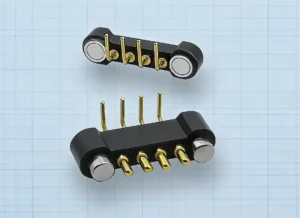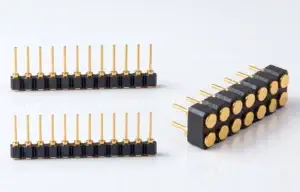
Magnetic pogo pin connectors may cost more than some conventional
connector alternatives at the component level, especially when the design
requires custom magnets, housings, tooling, cable assemblies or validation.
However, unit price is only one layer of the economic decision. OEM teams
should compare non-recurring engineering, recurring BOM, assembly,
inspection, qualification, field service, replacement and downtime costs
before deciding whether a magnetic interface produces a positive ROI.
Are Magnetic Pogo Pin Connectors Actually More Expensive?
Sometimes yes.

Sometimes no.

More importantly, the question cannot be answered from connector unit price
alone.

A magnetic pogo pin connector can contain more functional elements than a
simple two-piece connector:- spring-loaded contacts;
- mating targets;
- permanent magnets or magnetic steel components;
- custom plastic or metal housings;
- PCB, FPC, wire or cable terminations;
- mechanical guidance features;
- project-specific sealing structures;
- additional inspection or validation requirements.
These elements can increase the recurring component cost or the initial
development cost.

But another connector architecture may require:- a separate latch;
- a deeper enclosure cavity;
- additional fasteners;
- cable strain-relief structures;
- manual alignment during assembly;
- a more expensive device-side repair when the interface is damaged.
Therefore, a fair comparison should begin with:


    complete interface architecture versus complete interface architecture.
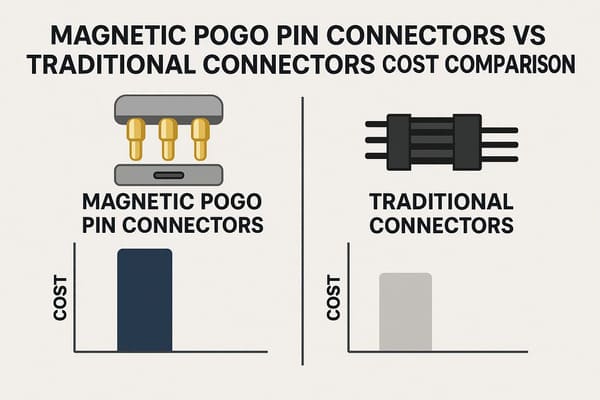
than the purchase price of one component.
Start with Total Cost of Ownership, Not Unit Price
For an OEM hardware program, total connector cost can be represented with a
simplified model:


    Program TCO =
    NRE
    +
    Tooling
    +
    Recurring BOM
    +
    Assembly
    +
    Inspection
    +
    Qualification
    +
    Scrap / Rework
    +
    Field Service
    +
    Replacement
    +
    Downtime
    +
    Supply-Risk Cost


At a unit level:


    TCO per Unit =
    Program TCO
    ÷
    Total Shipped Units


Not every project will use every cost category.

The purpose of the model is to prevent procurement teams from comparing:


    one magnetic connector quote
against:
only the bare price of an alternative connector.
Cost Layer 1: NRE, Tooling and Development Cost
Custom magnetic pogo pin connectors often require more engineering work
before production than an off-the-shelf standardized connector.
Possible non-recurring costs include:
- connector mechanical design;
- magnet layout development;
- custom housing design;
- molding tools;
- metal stamping or machining fixtures;
- assembly tooling;
- inspection fixtures;
- prototype builds;
- environmental or lifecycle validation.
Custom Does Not Automatically Mean Expensive
The development cost depends strongly on how much of the architecture can
reuse an existing platform.

Three projects may all be described as “custom magnetic connectors” but have
very different NRE requirements:| Customization Level | Typical Engineering Change | Potential Cost Impact |
|---|---|---|
| Platform Adaptation | Existing connector family with limited dimensional or cable changes | Lower development burden |
| Semi-Custom | New Pin Map, housing or termination using existing contact structures | Moderate engineering and tooling |
| Fully Custom | New geometry, contacts, magnets, housing and manufacturing process | Higher NRE and validation burden |
Amortize Tooling Over the Real Program Volume
Tooling should not be evaluated as a standalone cost.A simplified amortized tooling contribution is:
    Tooling Cost per Unit =
    Total Tooling Cost
    ÷
    Expected Program Volume


This is why the same custom connector can have a very different economic
result for:- a small pilot project;
- a medium-volume industrial product;
- a multi-year platform program.
Procurement should therefore provide realistic program volume rather than
only asking for a price at one order quantity.
Cost Layer 2: What Actually Drives Magnetic Pogo Pin Unit Price?
The recurring price of a magnetic connector is not determined by “magnetic”
versus “non-magnetic” alone.

The quote is influenced by the complete design.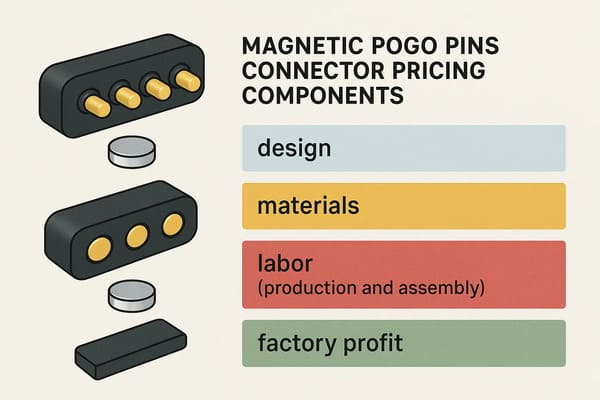
termination, tooling and inspection architecture.
| Cost Driver | Why It Matters |
|---|---|
| Pin Count | More contacts increase component and assembly complexity |
| Contact Size | Changes material use, geometry and manufacturing process |
| Working Stroke | Can affect pogo pin structure and spring design |
| Magnet Architecture | Number, geometry, grade, coating and assembly method affect cost |
| Housing | Custom molding or machined structures add tooling and process cost |
| Mating Target | The target is part of the complete contact system |
| Surface Finish | Material and plating requirements affect process cost |
| Termination | PCB, FPC, wire and cable assemblies have different labor and material structures |
| Environmental Structure | Molding, gaskets, potting or overmolding can add process steps |
| Tolerance | Tighter tolerances may require more capable processes and inspection |
| Testing | Force, electrical, magnetic or environmental inspection can affect recurring cost |
| Packaging | Bulk, tray and tape-and-reel requirements have different costs |
| Volume | Changes material purchasing, machine utilization and tooling amortization |
Cost Layer 3: Assembly Cost Can Change the Comparison
The connector with the lowest purchase price does not necessarily create the
lowest assembly cost.

Engineers should examine how the interface is installed into the product.
Assembly cost can include:
- manual positioning;
- fasteners;
- soldering;
- FPC or cable routing;
- adhesive application;
- seal installation;
- alignment;
- functional testing;
- rework.
A Magnetic Module May Consolidate Several Operations
In some designs, a supplier can provide one integrated module containing:- pogo pins;
- magnets;
- housing;
- target;
- FPC;
- wires or cable.
That may move part of the assembly work from the final device factory into
the connector subassembly.

Whether this produces savings depends on:- module price;
- device assembly time;
- yield;
- inspection requirements;
- rework rate;
- supply strategy.
Blind Mating Only Creates ROI If It Removes a Real Operation
Magnetic capture can reduce alignment effort in some assembly or docking
processes.

But procurement should not assign a cost saving simply because a connector
is described as “blind mating.”

The economic question is:


    Does the interface measurably reduce assembly time, alignment fixtures,
    operator intervention or failed mating events in this process?


If it does not, there may be no assembly ROI to count.
Cost Layer 4: Qualification and Test Cost
A custom connector architecture can require additional engineering
validation before design release.
Depending on the project, this may include:
- working-stroke validation;
- contact-force measurement;
- voltage-drop testing;
- temperature-rise testing;
- retention and breakaway measurement;
- mating lifecycle;
- vibration or shock monitoring;
- environmental exposure;
- signal validation.
These costs should be included in the sourcing decision.Do Not Compare a Fully Qualified Custom Interface with an Unqualified Catalog Part
Procurement comparisons sometimes become distorted because one supplier
quote includes:- custom engineering;
- tooling;
- test fixtures;
- validation;
while the alternative quote includes only the catalog component.

An apples-to-apples comparison should normalize the project scope first.
Cost Layer 5: Field Service and Replacement Architecture
Field cost is where connector architecture can become economically important
for products with frequent mating or expensive service.

The key question is not:

“Does a magnetic connector never fail?”

It can fail.
The useful question is:
“When wear or damage occurs, what exactly must be replaced?”
Move the Wear Component to the Cheaper Side Where Possible
Consider a device where:- the main PCB is expensive;
- device disassembly is labor intensive;
- the charging cable is easily replaceable.
The interface can sometimes be designed so that more of the serviceable
contact structure is located on the cable or replaceable module side.
This creates a different service architecture:
    Expensive Device Repair
    ↓
    versus
    ↓
    Replaceable Cable / Target / Contact Module


The potential savings depend on the actual failure mode and service
procedure.
Field-Service Cost Should Be Measured Per Event
A useful model is:
    Cost per Connector Failure =
    Replacement Part
    +
    Labor
    +
    Logistics
    +
    Diagnosis
    +
    Customer Support
    +
    Downtime


The result can be much larger than the original connector purchase price in
field-serviceable B2B equipment.
Cost Layer 6: Downtime Can Dominate the Hardware Cost
In industrial, fleet, test or production equipment, the cost of a failed
interface can extend beyond repair.
Downtime cost may include:
- lost machine availability;
- missed charging cycles;
- operator intervention;
- maintenance visits;
- production interruption;
- replacement-device inventory.
This does not mean magnetic pogo pins automatically reduce downtime.

It means downtime should be included when evaluating any removable
high-use connector architecture.
Docking Reliability Can Have Economic Value
In an automatically docked system, the interface may create repeated costs
even before complete connector failure.
Examples include:
- multiple docking retries;
- operator-assisted reconnection;
- failed charging sessions;
- maintenance cleaning;
- connector replacement.
If a new interface reduces these events under validated field conditions,
the improvement can be included in the ROI model.
Cost Layer 7: Product-Platform Reuse Can Change the Economics
One custom magnetic interface can sometimes be reused across a product
family.
For example, a common host-side interface may connect:
- different charging docks;
- different removable modules;
- service fixtures;
- accessories;
- future product variants.
This can spread the original engineering and tooling investment across more
than one SKU.

However, platform reuse only works when the interface contract remains
controlled.
Compatibility should include:
- mechanical geometry;
- Pin Map;
- voltage;
- power architecture;
- signal logic;
- module identification;
- environmental requirements.
A Practical Magnetic Connector ROI Model
Let:- Cmag = recurring magnetic interface cost per unit;
- Calt = recurring alternative-interface cost per unit;
- Amag = magnetic-interface assembly and test cost;
- Aalt = alternative assembly and test cost;
- NREmag = magnetic-interface NRE and tooling;
- NREalt = alternative NRE and tooling;
- Fmag = expected field/service cost;
- Falt = expected field/service cost;
- Q = total program volume.
A simplified unit-level comparison is:


    TCOmag =
    Cmag
    +
    Amag
    +
    (NREmag ÷ Q)
    +
    Fmag
versus:
    TCOalt =
    Calt
    +
    Aalt
    +
    (NREalt ÷ Q)
    +
    Falt


The magnetic architecture creates an economic advantage only when:


    TCOmag < TCOalt


or when a higher TCO is justified by another measurable product requirement
such as user experience, modularity, serviceability or industrial design.
Calculate the Break-Even Point Instead of Assuming ROI
Define the recurring premium as:


    Connector Premium =
    (Cmag + Amag)
    -
    (Calt + Aalt)


Then include the amortized difference in development cost:


    Total Premium per Unit =
    Connector Premium
    +
    ((NREmag - NREalt) ÷ Q)


The project breaks even when measurable downstream savings per shipped unit
are at least equal to that premium.

Those savings might come from:- assembly reduction;
- lower service cost;
- lower replacement cost;
- reduced downtime;
- platform reuse.
If those benefits cannot be measured or are irrelevant to the product, the
higher connector cost should not automatically be justified as “ROI.”
Break-Even Field-Failure Model
When field service is the main economic argument, a simplified threshold can
be represented as:


    Required Reduction in Field Failures
    =
    Total Interface Premium
    ÷
    Cost per Field Failure


This equation is useful because it forces procurement to quantify the
assumptions.

If the connector premium is significant but a field failure is inexpensive,
changing the interface may never recover the cost.

If one failure requires:- device return;
- technician labor;
- product disassembly;
- replacement hardware;
- customer downtime;
then a relatively small improvement in field performance may have greater
economic value.
Do Not Assign ROI to Benefits You Have Not Measured
Procurement models become unreliable when qualitative claims are converted
into savings without evidence.| Claim | Evidence Needed Before Counting ROI |
|---|---|
| Faster Assembly | Measured cycle-time reduction |
| Lower RMA | Field or validation evidence linking failures to the interface |
| Longer Life | Representative lifecycle test with defined failure criteria |
| Lower Downtime | Documented service or docking-event reduction |
| Less Maintenance | Measured maintenance-frequency change |
| Platform Reuse | Confirmed reuse across future SKUs |
ROI should be an outcome of the data—not the starting assumption.When Magnetic Pogo Pin Connectors Can Be Economically Attractive
The architecture is often worth evaluating when the product has one or more
of the following economic characteristics:- frequent connection and disconnection;
- high field-service cost;
- expensive device-side repair;
- automatic or blind docking;
- meaningful downtime cost;
- a need for controlled breakaway;
- a product family that can reuse one interface platform;
- a strong need for a shallow removable external interface.
These conditions create potential value.

They do not ensure positive ROI.
When a Magnetic Pogo Pin Connector May Not Be Worth the Premium
A simpler conventional connector can be economically stronger when:- the interface is connected once during manufacturing and rarely touched again;
- mating frequency is very low;
- field replacement is inexpensive;
- standard USB or another interoperable interface is required;
- a positive mechanical lock is necessary;
- the product volume cannot reasonably amortize custom tooling;
- metallic contamination makes magnetic capture undesirable;
- blind mating and breakaway provide little system value.
In these cases, adding magnets and a custom spring-contact assembly may add
cost without creating enough system-level benefit.
How Procurement Should Compare Supplier Quotes
Send the same technical RFQ to every supplier and normalize the quote scope.| Quote Item | Questions to Normalize |
|---|---|
| Unit Price | Same connector revision and same annual quantity? |
| Tooling | What tooling is included and who owns it? |
| NRE | Engineering, samples and fixtures included? |
| Samples | Quantity and revision? |
| Validation | Which tests are included? |
| Target Side | Included in connector price or separate? |
| Cable / FPC | Complete assembly or connector only? |
| Packaging | Bulk, tray or tape-and-reel? |
| Inspection | Which CTQs are tested in production? |
| Capacity | Factory capacity or project-specific capacity? |
Volume Should Be Quoted as a Curve, Not One Number
A single price at one order quantity provides an incomplete sourcing
picture.

For a serious OEM project, request pricing across the expected volume
stages:


    Prototype
    →
    Pilot
    →
    Initial Mass Production
    →
    Forecast Volume


This helps procurement understand:- where tooling begins to amortize;
- where automation becomes practical;
- where material purchasing changes;
- how the program economics evolve over time.
operations and lifecycle economics across the full program.
Magnetic Pogo Pin Cost Decision Matrix
| Product Condition | Economic Question |
|---|---|
| Low Volume | Can tooling and NRE be amortized reasonably? |
| High Mating Frequency | Does the interface reduce measurable lifecycle or service cost? |
| Expensive Device Repair | Can the wear component be moved to a replaceable side? |
| Automated Docking | Does magnetic capture reduce docking retries or alignment hardware? |
| High Production Volume | Can tooling and automated processes reduce recurring cost? |
| Product Platform | Can one interface be reused across several SKUs? |
| Commodity Interface | Does customization create enough value to justify the premium? |
Information Needed for an Accurate Magnetic Connector Cost Review
| Project Input | Information to Provide |
|---|---|
| Application | What are the two assemblies being connected? |
| Mechanical Envelope | Available X, Y and Z space |
| Pin Map | Power, return, detection and signal requirements |
| Electrical Load | Voltage, continuous current, peak current and duty cycle |
| Working Stroke | Required compression window |
| Magnetic Behavior | Capture, retention and breakaway requirements |
| Environment | Temperature, moisture, sweat, dust, salt or chemicals |
| Termination | PCB, FPC, wire or complete cable assembly |
| Lifecycle | Expected mating profile and service requirement |
| Prototype Quantity | Engineering sample requirement |
| Annual Volume | Expected ramp and mature production demand |
| Field Cost | Estimated cost of inspection, repair, replacement or downtime |
Frequently Asked Questions
Are magnetic pogo pin connectors more expensive than traditional connectors?
They can have a higher component price, particularly for customized
assemblies. However, the correct comparison should include tooling,
assembly, validation, repair, replacement and lifecycle cost rather than
unit price alone.
Why do magnetic pogo pin connectors cost more?
Cost can increase because the interface may include spring contacts,
magnets, targets, custom housings, precision assembly, cable or FPC
integration, tooling and project-specific inspection.
Are magnetic pogo pin connectors always more expensive?
No. Price depends on pin count, dimensions, materials, housing, termination,
customization level, production volume and test requirements. Complete
system cost may also differ from the connector purchase price.
How should I calculate magnetic pogo pin connector ROI?
Compare the complete magnetic-interface TCO against the alternative,
including NRE, tooling, recurring BOM, assembly, testing, field service,
replacement and downtime. ROI should be based on measurable savings rather
than assumed connector advantages.
Can magnetic pogo pins reduce assembly cost?
They can when the architecture measurably removes alignment steps,
fastening operations, separate components or operator intervention. The
actual saving should be confirmed through production cycle-time and yield
data.
Do magnetic pogo pins reduce RMA costs?
They may reduce specific connector-related service costs in a properly
validated application, but this should not be assumed universally. The
existing field failure modes should first be identified and quantified.
How does product volume affect magnetic connector price?
Volume can affect tooling amortization, material purchasing, machine
utilization, packaging and automation. OEM teams should request pricing
across prototype, pilot and mass-production stages.
Should tooling be included in connector unit cost?
For program-level TCO analysis, tooling and NRE should normally be amortized
across the expected program volume so that different architectures can be
compared consistently.
Can a custom magnetic connector be cheaper than a standard connector?
At the individual component level, not necessarily. At the system level,
a custom interface may become economically competitive if it eliminates
other components, assembly operations or expensive service requirements.
When is a magnetic pogo pin connector usually worth evaluating?
It is particularly worth evaluating when the product has frequent mating,
blind docking, high field-service cost, expensive device-side repair,
controlled breakaway requirements or a product platform that can reuse the
same interface.
When may a magnetic pogo pin connector not be worth the cost?
A simpler connector may be more economical when the interface is rarely
disconnected, standardized interoperability is required, service cost is
low or custom tooling cannot be reasonably amortized.
What should I send a supplier for an accurate magnetic connector quote?
Provide the available connector space, Pin Map, voltage, current, working
stroke, magnetic behavior, environmental requirements, termination method,
prototype demand, annual forecast and available 2D or 3D files.
Request a Magnetic Connector Cost & Engineering Review
Explore

    CTP custom magnetic connector solutions

for removable charging, docking and modular interfaces.

Review

    pogo pin and spring-contact connector solutions

for project-specific contact structures.

Learn more about CTP engineering and manufacturing capabilities on the

    About Us page
.
Comparing connector architectures for a new OEM project?
Submit your connector envelope, Pin Map, voltage, current, working
stroke, magnetic requirements, annual forecast and available project
files to CTP for an engineering and cost review.
Where practical, the project can be evaluated for platform reuse,
standard-structure adaptation, custom tooling requirements and
production integration before the connector architecture is frozen.
Final pricing, tooling, lead time, performance specifications and
production capacity should be confirmed against the approved connector
revision and project-specific production plan.
CTP ENGINEERING PATHS
Choose the right path for your project
Move from application requirements to a connector pair, a data-capable cable assembly, or a charging cable configuration. Final specifications are confirmed against an approved drawing and project validation plan.
Magnetic Connectors
Connector geometry, pin layout, mechanical integration and OEM/ODM review.
Engineering overview → 02Magnetic Data Cables
Power and signal allocation, cable exit, interface selection and assembly review.
Cable engineering → 03Magnetic Charging Cables
Browse the complete cable catalog and shortlist a starting structure for customization.
View cable catalog →