
Pick up a handheld device, turn it toward you and set it down again. If a cable is attached, you immediately notice whether it moves comfortably with the product or keeps pulling your attention back to the connection. That everyday feel is a good reason to consider a flexible magnetic cable assembly early in the design.
At CTP, we offer several magnetic cable structures that can be developed around the way your product is handled. Cable length, conductor construction, jacket, outlet direction and strain relief are all part of that discussion. The aim is a lead that belongs with the device, both in the hand and in its normal resting position.
Our USB cable formats, round side-exit connections and branched assemblies provide different starting points. A desktop accessory, a handheld instrument and a product with two internal boards do not need to settle for the same cable arrangement.
A flexible magnetic cable assembly starts with the person holding the device
The person using a small product rarely thinks about its cable specification. They notice whether the lead reaches comfortably, whether it crosses a control and whether the device sits naturally when it is connected. Those observations are valuable design information.
Take a handheld instrument used at a workbench. It may spend most of its time beside a station, then be lifted and turned for a reading. A suitable lead gives the user enough reach for that movement without leaving an unnecessary coil beside the instrument. Its outlet direction also helps determine where the free cable falls.
Our custom approach makes those choices available together. You can describe the way the product moves and the space around it, then develop a cable construction for that use. A comfortable result comes from the relationship between the cable and the product, not simply from choosing the softest material description.
This is why the magnetic head matters as well as the lead. Its housing, seating position and cable exit affect the first bend in the cable. A well-placed outlet gives the flexible section room to move in the direction the user naturally takes it.
A familiar USB-A end can keep the everyday setup simple
The CTP USB-A magnetic cable, CTP-MCC-4P-USBA-DATA-01, combines a source-side USB-A plug with a linear four-contact magnetic head. It is a useful option when the device belongs with an existing USB-A station or accessory arrangement.
The four-contact magnetic head can suit a compact handheld product
The magnetic interface provides four electrical paths for the project’s required functions. Its linear shape gives the device team a clear mating face to place within the enclosure. Cable length, wire gauge, jacket and strain relief can then be developed around the expected handling.
For the workbench instrument, this could mean a source plug that stays familiar while the device-side connection suits the new product. The user can place the cable where it is comfortable to approach, rather than reaching for a small socket hidden behind a larger part of the housing.
The four contact assignments remain specific to the circuit. The product advantage is the combination of an established source-end format and a customizable magnetic connection, with the cable between them treated as part of the device experience.
A side-exit round connector helps the cable follow the surface
Some products work best with a cable that runs beside the housing. Our round magnetic data cable with a side outlet, CTP-MCC-RD-A09, has a concentric mating structure and a separate round mating component. The cable leaves from the side of the head.
A side cable outlet can make a desk accessory less awkward
Picture a small display or accessory positioned close to a panel. A cable projecting straight back from the connection might need to turn almost immediately. A side-exit structure gives the designer another starting direction, so the lead can follow the surface more naturally.
That can make the installed arrangement look cleaner and leave more room around the product. It may also help keep the cable away from a nearby control or mounting feature. The useful benefit is choosing an outlet that already points toward the available route.
This round design is offered for project-defined data and signal applications. Its electrical arrangement is developed for the required functions; the round appearance does not establish a universal protocol or rotation capability. Its visible advantage here is the side-exit structure and the routing choice it provides.
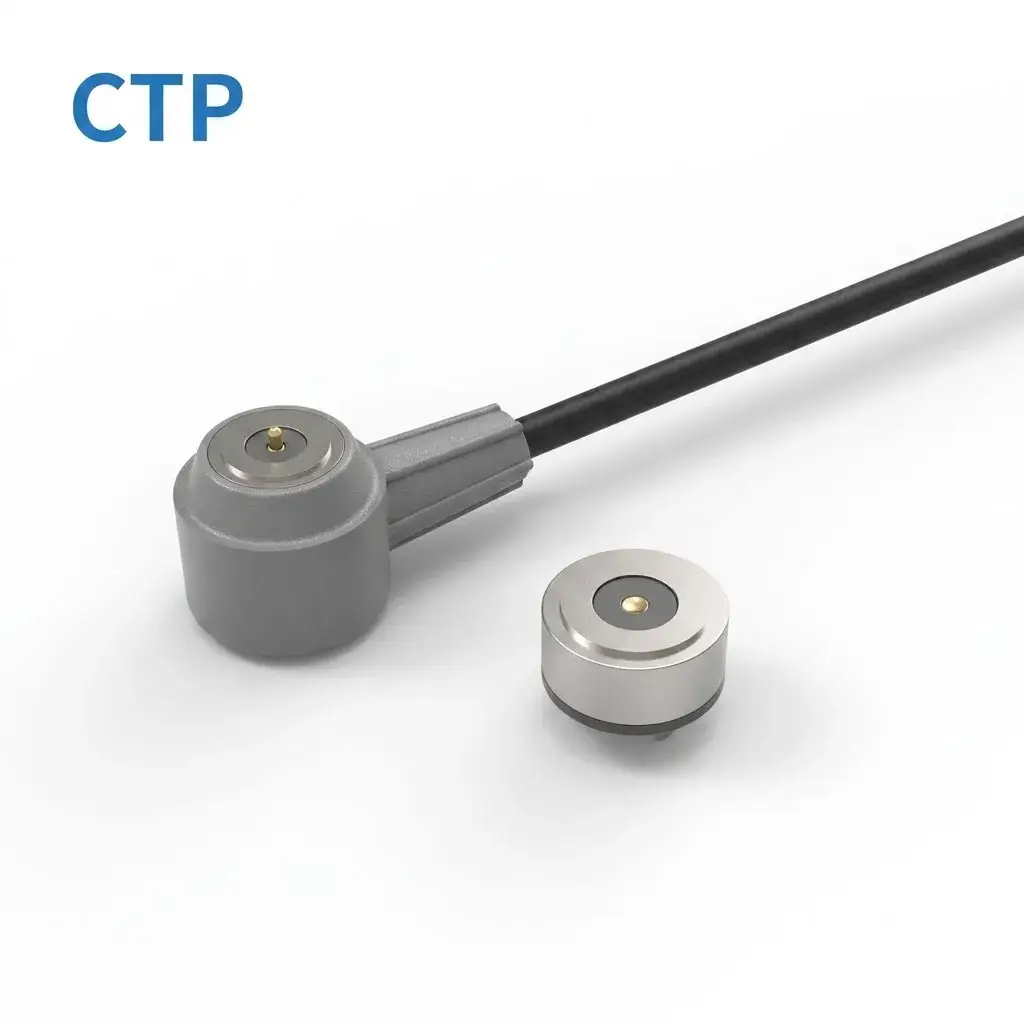
An axial lead is useful when the cable has room behind the connector
A side outlet is not automatically the best arrangement for every round interface. Our round magnetic connector with an axial cable lead, CTP-MC-1P-RD-A02, gives the cable a direct route from the rear of the connector.
That structure can suit a device with clear space behind the mating position. The cable can leave in line with the connection and form its bend farther away from the head, where the product layout allows it. It is a useful alternative when the lead naturally travels toward the back of the installation.
An axial cable lead can leave the sides of a round connection clear
For a small docking accessory, an axial route may help keep the cable away from nearby side controls or adjacent equipment. It can also create a visually direct line between the connector and the source-side route. The product team can compare that with the side-exit version using the actual enclosure space.
The central contact and complete return arrangement are defined for the project. What this catalog structure offers is a round magnetic interface with a rear lead, whose length, conductor construction and strain relief can be reviewed for the application.
Two branches let the flexible section reach the places that need it
A product with separated internal connections often needs more than a soft outside cable. The internal wiring has to reach different positions without becoming a bundle of spare length. Our six-contact magnetic assembly with dual-branch leads, CTP-MCC-6P-WH-DATA-01, provides a starting structure for that kind of layout.
The main cable and two branch lengths can be developed around their destinations. Terminal structures, conductor gauge, wire color and jacket can also reflect the device’s wiring requirements. This gives the harness a shape that relates to the product rather than leaving the final split to be improvised during assembly.
Imagine a compact instrument with a main board near the display and a sensing module near its lower edge. Different branch reaches can suit those two positions. A cable routed this way can leave a more orderly interior, with the available space used for the electronics and mechanical parts that need it.
The same principle applies when the device is opened for assembly or service. Branches need to move through the available space as the housing is brought together. Considering their lengths and terminations as part of the cable gives the product team a clearer arrangement to work with.
The jacket and strain relief shape how a flexible magnetic cable feels
A flexible lead is a combination of parts. The conductors, insulation, outer jacket and molded transition all influence its behavior. That is why a custom cable conversation is most useful when it includes the electrical requirement as well as the desired feel.
A lead serving a lightweight handheld accessory may need a different balance from one routed inside an instrument. Outside, handling and appearance are easy to notice. Inside, bend space, nearby edges and the route to the board may matter more. We can review the jacket, lead dimensions and outlet around those different priorities as part of the cable development.
Strain relief is particularly relevant near the magnetic head, where the lead changes from a supported connector structure to a flexible cable. Its shape can help the transition suit the intended direction of movement. Cable outlet and housing choices therefore belong beside jacket selection, rather than being treated as finishing details.
igus explains that bend radius depends on the cable and application. For a custom magnetic lead, that is a useful reminder to describe the real movement. A comfortable hand feel is valuable, while repeated bending or twisting needs its own agreed construction and validation.
A cable should feel appropriate when the product is put away too
Everyday use includes more than the moments when the device is operating. A portable product may be returned to a case. A desktop accessory may be pushed toward the back of a desk. A handheld instrument may be set beside a station between tasks. The cable’s free length and exit direction affect all of those small interactions.
For the portable instrument, a suitable lead can sit beside the device without dominating the available storage space. For the desk accessory, a side outlet may provide a convenient route along the housing. These are good reasons to look at the complete assembly in its normal surroundings.
The detachable magnetic interface is part of that flexibility. It gives the product a defined connection point that can be considered with its accessories and storage arrangement. The desired retention and release behavior can be developed around how the device is handled.
We do not infer a tested motion life from a cable’s photograph. If the application involves a repeated machine movement, continuous flexing or substantial torsion, those conditions become specific development requirements. That keeps the everyday-handling benefits of these structures separate from performance that needs application testing.
Leave room for the hand around the magnetic head
The first few centimeters beside a connector influence more than the cable’s bend. They also affect how the user reaches the connection. A lead that naturally falls away from the gripping area can make a small product feel less crowded, especially when its magnetic face sits close to a button or raised edge.
For a tabletop accessory, the side-exit round structure may help keep the free cable to one side of the housing. For a product with open space behind the connection, the axial lead may provide the more comfortable approach. Neither arrangement is a universal preference; their usefulness becomes clear when you hold the product in its normal position.
A prototype lets the team explore that interaction with the intended cable length and route. The user can reach the connector housing rather than treating the wire itself as the natural place to pull. The device can also be placed on its usual surface, so the lead’s position is judged as part of the whole product.
These small handling details are worth bringing into a custom cable discussion. Our housing, cable-outlet and strain-relief options provide specific features to work with. They allow the cable to support the product’s everyday comfort alongside its electrical function, rather than asking the user to adapt to an awkward connection.
Choose the cable movement that belongs with your product
The best starting point is often the simplest description of normal use: a device lifted from a desk, a cable running beside a panel or two internal connections reached through separate branches. That description makes the useful features of each cable format much easier to see.
The CTP magnetic cable collection gives you several ways to start. Our strain-relief and cable-exit guide looks more closely at the connector transition when the project needs that detail.
A flexible magnetic cable assembly should make the product comfortable to connect and natural to handle. With the right length, construction and outlet arrangement, the cable can fit into the device’s daily use quietly and neatly, which is exactly where a thoughtfully designed accessory belongs.