The true cost of importing pogo pins from China is the total amount required to receive usable, approved parts at the buyer’s facility—not only the unit price shown on the supplier quotation.
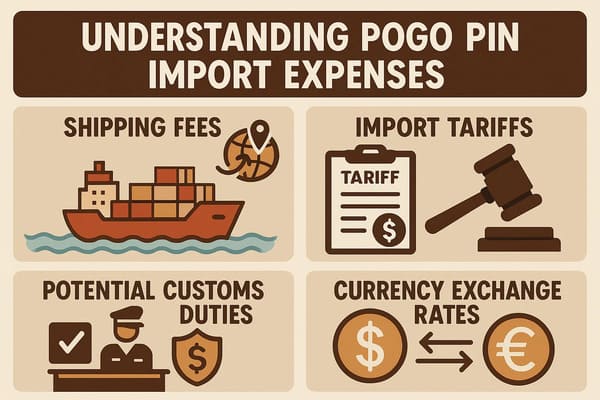
A complete cost calculation may include engineering samples, custom tooling, packaging, domestic transport in China, international freight, insurance, customs clearance, import duties, taxes, inspection, rejected parts, inventory financing and warranty exposure.
The cost structure also changes according to the product being purchased. Loose pogo pins, pin receptacles, assembled pogo pin connectors, magnetic connector modules and finished magnetic cable assemblies do not have the same manufacturing, packaging, shipping or customs profile.
To calculate the true pogo pin import cost, add every cost required to develop, manufacture, transport, clear, inspect and hold the goods, then divide the total by the number of accepted units—not simply by the number ordered.
What Is the Landed Cost of a Pogo Pin?
Landed cost is the total cost of bringing the product from the supplier to the agreed destination in a usable condition.
A practical calculation is:
True cost per accepted unit =
Product cost
+ amortized tooling and engineering cost
+ packaging and inland transport
+ international freight and insurance
+ customs duties, taxes and clearance fees
+ inspection and quality-control cost
+ financing and inventory cost
+ sorting, rework and replacement cost
+ expected warranty and field-support cost
÷ accepted units
The use of accepted units is important. If the buyer pays for a complete order but some products are rejected, damaged or unusable, the effective cost of each usable unit increases.
The 12 Main Components of Pogo Pin Import Cost
| Cost category | Examples | Common purchasing mistake |
|---|---|---|
| Product price | Pogo pins, housings, magnets, PCB, FPC, cable and assembly. | Comparing quotations with different specifications. |
| Engineering and NRE | Drawing, DFM, prototype fixtures and custom development. | Ignoring development charges when calculating unit cost. |
| Tooling | Plastic molds, overmolding molds, stamping tools and inspection fixtures. | Amortizing tooling over an unrealistic production volume. |
| Samples | Prototype parts, sample shipping and multiple revision rounds. | Budgeting for only one sample round. |
| Packaging | Trays, tubes, tape and reel, moisture barrier and protective caps. | Using the cheapest packaging without considering contact damage. |
| Freight | Courier, air freight, sea freight and local delivery. | Comparing freight before confirming packed dimensions and weight. |
| Customs | Duty, import tax, brokerage, declarations and inspection charges. | Assuming every pogo pin product uses the same classification. |
| Quality control | Pre-shipment inspection, incoming inspection and laboratory testing. | Treating inspection as unnecessary because samples passed. |
| Yield loss | Rejected parts, sorting, rework and line fallout. | Dividing total cost by ordered quantity instead of accepted quantity. |
| Inventory | Safety stock, storage, financing and obsolescence. | Buying a large MOQ without reviewing design-change risk. |
| Delay risk | Expedited freight, line shortage and missed launch dates. | Using the supplier’s production lead time as the complete delivery time. |
| Field cost | Warranty replacement, service labor and customer returns. | Comparing suppliers only by purchase price. |
1. Product Price Depends on the Exact Pogo Pin Structure
A quotation for “pogo pins” is not meaningful without a controlled technical specification.
Unit price may be influenced by:
- plunger and barrel diameter;
- overall length and working stroke;
- spring-force range;
- tip geometry;
- contact material;
- surface finish and plating requirements;
- machining complexity;
- dimensional tolerances;
- mounting method;
- order quantity;
- inspection and testing requirements.
A low quotation may refer to a different material, plating specification, tolerance or testing level than a higher quotation.
Normalize the technical specification before comparing prices
Every supplier should quote against the same:
- drawing revision;
- finished dimensions;
- working stroke;
- spring-force requirement;
- contact and plating specification;
- current and resistance criteria;
- packaging method;
- inspection plan;
- annual volume.
Cost Differences by Product Type
| Imported product | Main cost drivers | Cost often overlooked |
|---|---|---|
| Individual pogo pins | Dimensions, materials, plating, stroke, force and quantity. | Packaging, placement loss and customer-side assembly. |
| Pin receptacles | Mating range, internal clip, shell design and mounting style. | PCB-hole tolerance and press-fit tooling. |
| Pogo pin connector assembly | Pin count, housing, PCB, FPC, soldering and inspection. | Plastic tooling, assembly fixtures and coplanarity control. |
| Magnetic connector module | Pogo pins, magnets, housing, polarity control and retention testing. | Magnet fixtures, adhesive, mating counterpart and force variation. |
| Magnetic cable assembly | Connector head, cable, PCB, overmolding, strain relief and testing. | Cable-flex testing, overmold tooling and packed volume. |
2. Engineering, NRE and Prototype Costs
Custom connector projects may require non-recurring engineering costs before mass production begins.
Possible NRE items include:
- engineering review;
- 2D and 3D drawing development;
- DFM analysis;
- custom pogo pin machining setup;
- prototype housing production;
- assembly fixtures;
- electrical test fixtures;
- sample assembly;
- validation testing;
- drawing revisions.
Calculate amortized NRE realistically
Do not divide tooling or development costs by an optimistic sales forecast unless the design is stable and the forecast is supported.
If the product is likely to change after pilot production, early tooling may need to be modified or replaced.
3. Tooling Cost and Ownership
The word “tooling” may describe several different items:
- plastic injection molds;
- insert-molding molds;
- cable-overmolding molds;
- stamping tools;
- assembly nests;
- pogo pin installation fixtures;
- magnet-polarity fixtures;
- inspection gauges;
- electrical test fixtures.
Before accepting the tooling quotation, confirm:
- what equipment is included;
- who owns the tooling;
- where it will be stored;
- expected service life;
- maintenance responsibility;
- cost of inserts and wear parts;
- whether the tooling can be transferred;
- what happens after a design revision;
- whether sample and mass-production tooling are the same.
4. Sample Cost Is More Than the Sample Price
A sample order may include several separate expenses:
- sample parts;
- prototype tooling;
- engineering labor;
- international courier;
- customs processing;
- customer testing;
- fixture modification;
- additional sample rounds;
- project-management time.
The buyer should budget for more than one development round when the connector is integrated into a new enclosure, PCB or magnetic interface.
Sample-stage cost by project maturity
| Project stage | Primary purpose | Cost risk |
|---|---|---|
| Concept sample | Confirm basic size and function. | May not use final materials or processes. |
| Engineering sample | Verify electrical and mechanical design. | Further enclosure or PCB changes may be required. |
| Tooling sample | Verify molded or production-intent parts. | Tool modification may create additional charges. |
| Pilot lot | Verify the intended production process. | Low-volume unit cost may be higher than mass production. |
5. Packaging Can Change Both Quality and Freight Cost
Pogo pins are small, but improper packaging can damage plungers, bend terminations, contaminate contact surfaces or create difficulties in automated assembly.
Packaging options may include:
- bulk bags;
- layered trays;
- plastic tubes;
- carrier strips;
- tape and reel;
- individual protective caps;
- vacuum or moisture-resistant packaging;
- custom export cartons.
Packaging questions
- Can the pogo pins contact and damage each other?
- Are plungers protected from continuous compression?
- Is the packaging compatible with automated placement?
- Does the tray or reel add significant dimensional weight?
- Are lot codes visible without opening the package?
- Can the package be resealed after incoming inspection?
- Does the packaging prevent metal debris or adhesive contamination?
The cheapest packaging is not always the lowest-cost option if it increases inspection, handling or assembly losses.
6. Incoterms Change Which Costs Appear on the Supplier Quote
The quotation should state the Incoterms rule, version and named location. A quotation that says only “FOB price” or “DDP price” is incomplete without the corresponding place or destination.
| Trade term | General cost visibility | Buyer should verify |
|---|---|---|
| EXW | Supplier price may exclude pickup, export handling and most transportation. | Pickup access, export arrangements and local China charges. |
| FCA | Seller delivers to the named carrier or location under the agreed responsibilities. | Exact handover location and charges after handover. |
| DAP | Transportation to the named destination is generally included. | Import clearance, duties, taxes and unloading responsibilities. |
| DDP | The quotation may include delivery and import formalities. | Importer identity, duty documentation, tax treatment and excluded local charges. |
Do not compare an EXW quotation with a DDP quotation by unit price. Convert both quotations to the same destination and cost boundary first.
7. International Freight Depends on More Than Product Weight
Pogo pins are usually compact, but connector trays, cable assemblies and protective packaging can increase chargeable volume.
Express courier
Express services are commonly evaluated for:
- engineering samples;
- urgent replacement parts;
- small production lots;
- high-value, low-weight components.
Request a quotation based on the final packed weight and carton dimensions rather than the estimated net product weight.
Air freight
Air freight may be considered for larger urgent shipments. The complete cost can include:
- pickup;
- export handling;
- airport charges;
- main freight;
- security charges;
- customs brokerage;
- destination handling;
- final delivery.
Sea freight
Sea freight may suit stable, larger-volume orders, especially when the product includes bulky cable or molded assemblies.
For small less-than-container shipments, origin and destination charges can represent a significant part of the total freight bill. Obtain a door-to-door estimate before selecting the transport method.
8. Customs Classification Must Match the Imported Product
There is no universal customs code that can safely be applied to every product described as a pogo pin.
The classification may depend on whether the imported item is:
- an individual spring-loaded contact;
- a pin receptacle;
- a multi-pin connector assembly;
- a magnetic connector module;
- a cable assembly with connectors;
- a component designed primarily for a specific machine or device.
Classification may affect:
- customs-duty rate;
- additional tariffs or trade measures;
- documentation;
- import restrictions;
- statistical reporting;
- origin requirements.
Information to give the customs broker
- detailed product description;
- product photographs;
- materials;
- electrical function;
- whether it is sold with a housing or cable;
- technical drawing;
- end-use information;
- country of manufacture;
- commercial invoice;
- packing list.
For significant or recurring imports, obtain formal classification advice or an advance ruling where the destination-country procedure allows it.
9. Customs Value Is Not Always the Same as the Simple Unit-Price Total
Customs authorities may require a declared value based on the applicable valuation rules in the destination country.
Depending on the transaction and jurisdiction, the customs value may require review of:
- price paid or payable;
- packing costs;
- tooling or assists supplied by the buyer;
- royalties or licence fees;
- commissions;
- freight and insurance treatment;
- related-party transactions;
- currency conversion.
Do not assign an artificial zero value to samples or understate the invoice value merely to reduce duty. The declared value should be supportable under the destination-country rules.
10. Duties, Import Taxes and Clearance Fees Must Be Separated
The amount paid at import may contain several different charges:
- customs duty;
- import VAT, GST or another consumption tax;
- customs processing fees;
- brokerage;
- courier advancement fees;
- port or terminal charges;
- inspection fees;
- storage or demurrage after a clearance delay;
- local delivery charges.
These charges should not all be grouped into one percentage.
Separate expense and cash-flow treatment
Import taxes may have different accounting or recoverability treatment depending on the importer’s jurisdiction and tax status. The landed-cost model should therefore distinguish:
- non-recoverable product and duty cost;
- potentially recoverable import tax;
- brokerage and processing fees;
- temporary cash-flow requirement.
Confirm the treatment with the buyer’s customs broker, accountant or tax adviser.
11. Quality Cost Should Be Calculated Before the Order
Quality cost is not limited to defective parts. It includes every activity required to prevent, detect and correct nonconforming products.
Prevention cost
- engineering review;
- supplier sample approval;
- drawing control;
- fixture development;
- pilot production;
- process validation.
Inspection cost
- pre-shipment inspection;
- incoming dimensional inspection;
- contact-resistance testing;
- spring-force testing;
- magnet-polarity inspection;
- retention-force testing;
- functional testing in the finished device.
Failure cost
- sorting;
- rework;
- scrapped parts;
- production-line interruption;
- expedited replacement shipping;
- warranty replacement;
- field-service labor;
- customer return handling.
Calculate the Cost per Accepted Unit
A lower purchase price does not necessarily produce a lower accepted-unit cost.
This calculation should be repeated after pilot production and the first mass-production order using actual results.
12. Lead Time Creates Inventory and Shortage Cost
The complete replenishment time may include:
- purchase-order confirmation;
- material procurement;
- component manufacturing;
- plating or outsourced processing;
- connector assembly;
- curing or molding;
- inspection;
- export preparation;
- international transport;
- customs clearance;
- incoming inspection.
A long or variable replenishment cycle can require additional safety stock.
Inventory-related costs
- cash tied up in stock;
- warehouse space;
- insurance;
- handling;
- cycle counting;
- damage or contamination;
- design obsolescence;
- excess inventory after demand changes.
A low MOQ may reduce inventory risk even when the unit price is slightly higher. A large MOQ may reduce unit price but increase exposure to product revisions and demand uncertainty.
13. Payment Terms and Currency Affect the Final Cost
International purchasing may also include:
- bank-transfer fees;
- currency-conversion spread;
- payment-platform fees;
- letter-of-credit charges;
- deposit financing;
- exchange-rate movement between deposit and balance payment;
- credit-insurance cost.
Normalize supplier quotations into the same currency and payment schedule before comparison.
14. Compliance Documents May Add Project Cost
Customers may request documents or testing related to:
- material declarations;
- restricted-substance requirements;
- conflict-mineral reporting;
- country-of-origin documentation;
- material safety information;
- product-specific test reports;
- customer quality agreements.
Confirm whether the quotation includes:
- existing supplier declarations;
- new third-party laboratory testing;
- report renewal;
- testing of the exact production part;
- documentation for each production lot.
A component declaration does not automatically certify the buyer’s complete finished device.
15. Warranty and Field Failure Belong in the Cost Model
The field cost of a connector failure depends on where the connector is installed.
One failed pogo pin may require:
- replacement of a small contact module;
- replacement of a complete magnetic cable;
- disassembly of the finished device;
- replacement of the main PCB;
- technician travel;
- customer downtime;
- return freight;
- diagnostic labor.
Expected field-cost model
This estimate should be based on project evidence and updated after pilot or field data becomes available. It should not be based on unsupported universal failure-rate claims.
How to Normalize Two Pogo Pin Supplier Quotations
| Comparison item | Supplier A | Supplier B |
|---|---|---|
| Drawing revision | Confirm | Confirm |
| Order quantity | Normalize | Normalize |
| Materials and plating | Compare specification | Compare specification |
| Tooling and NRE | Add separately | Add separately |
| Included tests | List evidence | List evidence |
| Packaging | Confirm format | Confirm format |
| Incoterms and location | Normalize destination | Normalize destination |
| Freight and clearance | Add estimated cost | Add estimated cost |
| Lead time | Include inventory impact | Include inventory impact |
| Expected accepted yield | Use evidence | Use evidence |
| Cost per accepted unit | Calculate | Calculate |
Step-by-Step Pogo Pin Landed-Cost Calculation
- Define the imported product. State whether it is an individual pin, connector, magnetic module or cable assembly.
- Freeze the technical quotation basis. Use the same drawing, materials, test requirements and quantity for all suppliers.
- Separate recurring and non-recurring costs. Identify unit price, samples, NRE, tooling and fixture charges.
- Confirm the Incoterms rule and named place. Determine which transport and clearance costs remain with the buyer.
- Obtain final packaging data. Request carton quantity, net weight, gross weight and dimensions.
- Request a door-to-door freight estimate. Compare courier, air and sea options where applicable.
- Verify customs classification and origin. Use the destination-country tariff system or professional customs advice.
- Estimate duties, taxes and clearance charges. Keep recoverable tax separate from permanent cost where appropriate.
- Add inspection and accepted-yield assumptions. Include pre-shipment and incoming quality-control expenses.
- Add inventory and financing costs. Consider deposit timing, transport duration and safety stock.
- Add expected delay and field-quality cost. Use realistic project evidence rather than marketing claims.
- Divide by accepted units. Compare suppliers using the final cost per usable unit.
Information Required for an Accurate Import-Cost Estimate
A useful landed-cost estimate requires:
- destination country and delivery address;
- buyer or importer-of-record arrangement;
- exact product description;
- individual pin, connector module or cable-assembly status;
- drawing and revision;
- order quantity and annual forecast;
- unit price and currency;
- sample, NRE and tooling charges;
- Incoterms rule, year and named place;
- carton quantity and dimensions;
- net and gross shipment weight;
- proposed shipping method;
- customs classification review;
- country of origin;
- inspection and testing requirements;
- expected accepted yield;
- payment terms;
- required safety stock;
- warranty and field-service assumptions.
Common Pogo Pin Import-Cost Mistakes
Comparing only the unit price
The lowest quoted unit price may exclude tooling, packaging, testing, freight and import charges.
Comparing different Incoterms
An EXW price and a DDP price represent different cost boundaries.
Assuming every pogo pin has the same customs code
Loose contacts, completed connectors and cable assemblies may require different classification analysis.
Ignoring packaging volume
Tape-and-reel, trays and finished cable assemblies may create a higher freight charge than net product weight suggests.
Using ordered quantity instead of accepted quantity
Rejected, damaged and unusable parts increase the effective cost of the remaining accepted units.
Amortizing tooling over an unrealistic forecast
A design revision or discontinued project may prevent the forecast volume from being reached.
Ignoring the cost of long lead times
A long replenishment cycle may require more inventory and create higher shortage risk.
Treating import VAT or GST as identical to customs duty
They may have different calculation, accounting and recovery treatment.
Accepting a DDP price without supporting records
The buyer should confirm who completes the import declaration and how duties and taxes are documented.
Using a low invoice value to reduce customs cost
The declared customs value must follow the applicable valuation rules and should be supported by transaction records.
When Importing Directly from China May Not Be the Lowest-Cost Option
Direct importing may not be economical when:
- the required quantity is very small;
- the buyer cannot manage customs clearance;
- the project requires immediate local stock;
- the design is still changing frequently;
- incoming inspection capability is limited;
- the cost of a production interruption is very high;
- local technical support is mandatory;
- the buyer needs broad compatibility with an existing standard product.
In these cases, purchasing through a local distributor, stocking partner or regional service provider may justify a higher unit price by reducing lead time, minimum quantity and administrative workload.
Frequently Asked Questions
How much does it cost to import pogo pins from China?
There is no universal figure. The cost depends on product structure, quantity, tooling, packaging, freight, customs classification, origin, destination-country duties and taxes, inspection and accepted yield.
Are pogo pin customs duties the same in every country?
No. Duty treatment depends on the destination country, product classification, customs value, origin and any applicable trade measures.
What is the cheapest shipping method for pogo pins?
The answer depends on shipment weight, volume, urgency and destination charges. Express courier is often evaluated for samples and small lots, while larger stable orders may justify air or sea freight comparison.
Does DDP include every import cost?
A DDP quotation is intended to allocate extensive delivery and import responsibilities to the seller, but the buyer should still confirm the named destination, importer arrangement, tax documentation and any excluded local charges.
Should tooling cost be included in the pogo pin unit price?
Tooling may be charged separately or amortized into the unit price. Buyers should calculate both the immediate cash requirement and the amortized cost over a realistic production volume.
Are magnetic pogo pin connectors more expensive to import?
They may have higher product and assembly cost because they can include magnets, housings, PCBs, cables and additional testing. The freight and customs treatment also depend on whether the imported product is a component, connector module or finished cable assembly.
How can I compare two China pogo pin suppliers?
Normalize the drawing, materials, quantity, tooling, packaging, testing, Incoterms, freight boundary and payment terms. Then compare the expected landed cost per accepted unit.
Do samples have customs value?
Customs treatment varies by destination, but a sample should not automatically be declared at zero value. Use a supportable value and follow the destination-country rules.
What hidden cost is most commonly missed?
Commonly missed items include sample revisions, tooling modifications, packaging, destination handling, incoming inspection, rejected units, safety stock and expedited replacement freight.
Can a supplier provide an exact landed cost?
A supplier can provide a quotation under an agreed delivery term, but the buyer or importer should verify customs classification, tax treatment and destination-country charges before treating the figure as final.
Conclusion
The true cost of importing pogo pins from China cannot be determined from unit price alone.
Buyers should first define the exact product and technical requirements, then separate recurring product cost from samples, NRE and tooling. Freight must be calculated using final packaging data, while customs duty and import tax must be based on the destination, classification, origin and applicable valuation rules.
Quality, inventory and field-support costs should also be included. The most useful comparison is the landed cost per accepted unit, not the supplier’s quoted price per ordered unit.
CTP supports custom development of individual pogo pins, pogo pin connector assemblies, magnetic pogo pin connectors and magnetic cable assemblies.
For a more accurate quotation, submit the product drawing, pin count, materials, quantity, destination country and preferred delivery term through our Get a Quote & Samples page or email bella@ytanpogo.com. Product, tooling, packaging and delivery costs can then be separated clearly in the quotation.