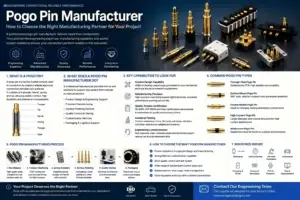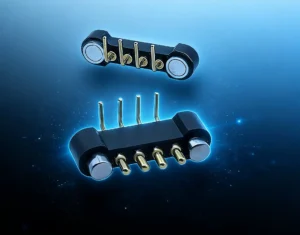
When designing a new electronic device, the physical connection point is often the most vulnerable part of the hardware. While standard off-the-shelf ports might seem convenient, complex projects—from medical monitors to industrial drones—demand a tailored approach.
Choosing the right custom spring-loaded magnetic connector goes far beyond just matching the shape. To ensure long-term reliability and optimal performance, hardware engineers must evaluate several critical parameters. Here is a comprehensive guide to help you specify the perfect magnetic solution for your application.
Standard vs. Custom Magnetic Connectors
| Feature | Standard Off-the-Shelf | CTP Custom Solutions |
|---|---|---|
| Current Capacity | 1A – 3A | a project-defined current requirement (High-power design) |
| Waterproof Rating | Usually none or IP54 | IP68 (Insert Molding Technology) |
| Magnetic Force | Fixed / Weak | Customizable (a project-specified magnet grade Neodymium) |
| Shape & Size | Fixed dimensions | 100% Tailored to your device |
1. Define Your Electrical Requirements (Power & Data)
The first step is determining what needs to pass through the connector.
Current & Voltage: Are you transmitting simple sensor data, or are you charging a large battery? Standard pins handle 1A to 3A, but for high-power devices like e-mobility or fast-charging industrial tools, you need specialized internal structures (like crown springs) that can handle continuous currents a project-defined current requirement without dangerous temperature rises.
Pin Count: Calculate exactly how many pins you need for power, ground, and data transfer. Custom magnetic connectors can be engineered with anywhere from 2 pins to over 20 pins in a single, compact housing.
2. Assess the Operating Environment (IP Rating & Corrosion)
Where will your device be used? The environment dictates the materials and sealing technologies required.
Water & Dust (IP Rating): If your device is used outdoors or requires sterilization, standard assembly won’t work. Look for connectors manufactured with Insert Molding technology, which fuses the pins directly into the plastic (like LCP) to achieve a true IP68 waterproof rating.
Chemical & Sweat Exposure: For smart wearables or medical devices, human sweat and harsh disinfectants can cause rapid galvanic corrosion. Specifying a thicker gold plating (e.g., 30μ" or 50μ" Au) or specialized coatings like Ruthenium is critical for longevity.
3. Determine the Magnetic Retention Force
One of the biggest advantages of magnetic connectors is the "blind mating" and "safety breakaway" features. However, the magnetic pull force must be precisely tuned to your use case.
If the device is a lightweight wearable, a moderate pull force ensures it detaches safely without dragging the device if snagged.
If it’s an industrial robotics connection subject to heavy vibration, you will need high-grade a project-specified magnet grade Neodymium magnets engineered for maximum retention force to prevent accidental disconnections.
4. Mechanical Durability and Lifecycle
How many times will the user plug and unplug this device? Traditional USB ports degrade quickly over a few thousand cycles. High-quality magnetic pogo pin connectors, when properly engineered, can easily exceed 10,000 to 50,000 mating cycles. Ensure your manufacturer utilizes precise spring-force calculations to prevent pin fatigue over time.
- Partner with a True Custom Manufacturer
Ultimately, the most important choice is your manufacturing partner. Designing a magnetic connector is a collaborative process. “Off-the-shelf” solutions often force you to compromise on your device’s ID (Industrial Design) or performance. By working directly with a source manufacturer like CTP, you get access to deep engineering expertise, structural evaluation, and rapid prototyping designed specifically for your hardware.
Want to see how different industries apply these principles?
Read our recent breakdown on [Why Medical, Wearable, and Industrial Sectors are Switching to Custom Magnetic Connectors].
Need to understand the basics first? Check out our [practical Guide to Spring-Loaded Magnetic Connectors].
Start Your Custom Design Today
Stop compromising on connectivity. Contact the engineering team at CTP today with your project specifications, and let us design the practical magnetic connector for your next breakthrough product.
FAQ about Custom Magnetic Connectors
Can magnetic connectors transmit both power and data?
Yes. Custom magnetic pogo pin connectors can be engineered with multiple pins. For example, a 4-pin or 6-pin layout can dedicate specific pins for high-speed data transfer while using the remaining pins for fast charging.
How many amps can a pogo pin connector handle?
While standard pins handle around 2A, advanced custom manufacturers like CTP utilize complex internal structures (such as crown spring designs) to safely transmit continuous high currents a project-defined current requirement without overheating.
CTP ENGINEERING PATHS
Choose the right path for your project
Move from application requirements to a connector pair, a data-capable cable assembly, or a charging cable configuration. Final specifications are confirmed against an approved drawing and project validation plan.
Magnetic Connectors
Connector geometry, pin layout, mechanical integration and OEM/ODM review.
Engineering overview → 02Magnetic Data Cables
Power and signal allocation, cable exit, interface selection and assembly review.
Cable engineering → 03Magnetic Charging Cables
Browse the complete cable catalog and shortlist a starting structure for customization.
View cable catalog →