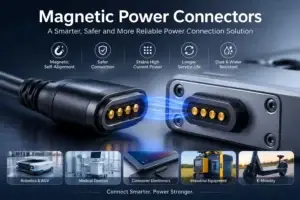
A round connector can look right at home on a compact device. Its outline works with curved surfaces, rounded accessories and circular panel openings, while the magnetic connection keeps the removable part easy to approach. For a product designer, that is an appealing combination of appearance and everyday use.
CTP offers several circular and ring-type interfaces, from a three-contact pair to a sixteen-contact cable assembly. Round magnetic connector orientation is developed around the chosen contact pattern and the way the accessory will be used. This gives your team room to choose a suitable face, circuit arrangement and cable route without treating every round connection as the same product.
Why a circular magnetic interface belongs in the design discussion
The connector is often one of the few functional features visible on the outside of an electronic device. Its shape affects how the enclosure looks and how the user finds the connection. A circular interface gives the team a compact visual boundary to work with, particularly on a rounded housing where a long rectangular opening would lead to a different design.
Magnetic attachment adds another benefit. The removable head can be brought towards the mating area rather than pushed into a deep socket. The magnets assist the approach, while the selected housing and contact geometry establish the seated relationship. That makes a circular magnetic interface worth considering for charging accessories, removable modules and custom cable connections.
Our magnetic connector range includes these round formats alongside other shapes. It lets the industrial designer and electrical team discuss their requirements together. The preferred outline can be compared with the number of circuits, mounting method and space behind the panel before the enclosure becomes difficult to change.
A three-contact circle for a focused device interface
CTP-MC-R10-3P-S01 combines a round face with three electrical paths
The CTP-MC-R10-3P-S01 provides a three-contact magnetic mating structure in a circular format. It is a useful starting point when the product needs a compact interface with a defined set of circuits. The pin assignment follows the project, rather than imposing the same third-contact function on every device.
For a charging accessory, that additional path might be considered for identification or another control function alongside power and return. For another product, the allocation may differ. What remains useful is the combination of a small circular face and a matching pair whose electrical role can be developed with the device.
The mounting view also matters to the appearance. A connector that suits the front panel still needs a sensible route behind it. By discussing the contact pattern, installed position and termination together, the team can develop a round connection that belongs to the complete enclosure rather than just looking attractive in a front-view sketch.
Five round contacts create room for more accessory functions
The CTP-MPC-5P-RD-HT-A01 five-contact round pair offers another arrangement for a circular interface. Its spring-contact and target halves provide a real product format to compare when three positions do not cover the required circuits. This keeps a round design direction available while the accessory gains more functions.
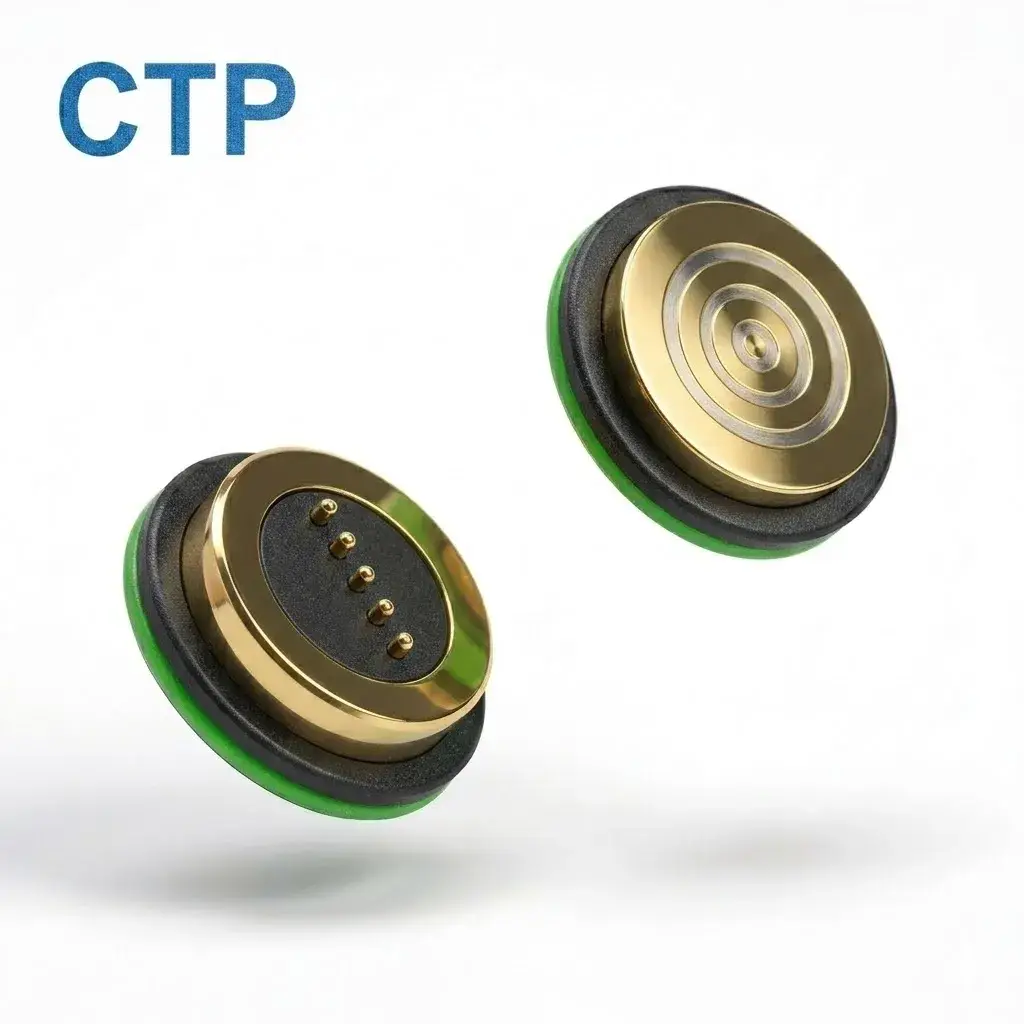
More functions at one visible connection
A removable accessory may need charging, identification and control paths at the same point. Bringing them into one mating area can give the user a simpler external connection, even when the circuitry behind it is more involved. The five-contact pair provides a structure for discussing that combination with the enclosure and electronics together.
This can be valuable for a product where an extra external socket would interrupt the intended appearance or complicate the accessory. The benefit is a connection organised around the complete task. The exact allocation, current and signal requirements are developed for the selected assembly, so the additional contacts are used for functions the product actually needs.
Ring-type targets offer another way to arrange a round face
The CTP four-contact ring pair has a different contact-and-target arrangement from the other round options. It gives the project another geometry to compare with its circuit and mounting requirements. The available alternatives are useful because a circular opening does not dictate one internal contact pattern.
How much freedom should the cable have?
For a wearable lead, the user may want the cable to point away from a strap. For a desktop device, the preferred direction may be towards the rear of the stand. These are straightforward product requirements that can guide the discussion of allowed orientations and the selected target geometry.
There is an important distinction between choosing a stationary attachment angle and turning continuously while connected. A round or ring-shaped face does not, by itself, establish a slip-ring function. CTP develops the orientation requirement for the actual pair and application, allowing the design to focus on the freedom the user needs rather than an undefined promise of rotation.
That makes the product brief easier to use. “The cable needs to clear this strap in either permitted attachment position” describes a real benefit. It lets the team consider the electrical pattern, lead exit and enclosure at the same time. The resulting choice can be simpler and more relevant than requesting unrestricted movement that the product will never use.
A circular cable assembly for a broader equipment connection
The CTP-MCC-16P-RND-PAIR-DATA-01 brings sixteen contacts into a circular cable-and-receptacle arrangement. This is a different supply scope from selecting a small connector component. It gives the OEM a magnetic cable format to discuss when several project-defined power, signal and control paths need to reach the device.
The matching receptacle provides the device-side interface, while the lead carries the assigned functions onwards. Cable length, conductors and the opposite-end arrangement are considered for the project. This lets the connection be developed across both sides of the device boundary, rather than leaving a multi-contact head to be combined with an unrelated cable later.
For equipment with a detachable multi-function lead, that coordinated scope is a practical advantage. The circular face can be reviewed with the panel, and the cable route can be considered with the surrounding equipment. The number of positions creates allocation choices, while the complete electrical channel determines the supported power and data functions.
CTP also offers a four-contact magnetic cable with a USB-C opposite end for a more focused assembly discussion. Comparing the two helps distinguish the actual requirement: a smaller set of connections at one lead, or a broader multi-contact cable. The plug shape alone does not decide which electrical functions a custom assembly provides.
The first cable bend is part of the round connector’s design
A round head can look tidy while its cable makes the product awkward to use. If the lead presses against the enclosure or is pulled tight around a stand, it can apply a lifting load at the interface. Thinking about the first bend early helps the magnetic connection serve the user’s movement as well as the industrial design.
With a finished CTP cable, the head, overmould and lead route can be discussed as parts of one assembly. The aim may be a cable that leaves a handheld device comfortably, reaches a source behind the desk or stays clear of another removable component. These requirements give the custom cable its purpose beyond simply connecting two plugs.
The cable-exit and strain-relief guide provides related considerations for that installation. On a circular interface, the most convenient electrical orientation and the most convenient cable direction need to work together. Bringing both into the development discussion helps avoid treating a visually neat head as a complete accessory on its own.
Find the round CTP format that suits the whole accessory
The three-contact pair suits a focused circuit discussion. The five-contact and ring-type options provide other contact arrangements. The sixteen-contact assembly addresses a broader cable connection, while a finished four-contact lead offers a smaller assembly route. Each gives the product team a different way to use a magnetic interface.
For round magnetic connector orientation, begin with the action the user should be able to perform and the circuits that must remain connected. Then compare the actual target layout, mounting and cable exit. The CTP spring-loaded connector guide explains the wider contact architecture behind those choices.
A round face can be a strong part of a product’s appearance, but it becomes more valuable when the rest of the accessory follows through. The right CTP pair gives the face its electrical role; the right mounting and lead route let it work comfortably in the device. That is the design opportunity worth exploring, whether the product needs a simple charging connection or a multi-function circular cable.