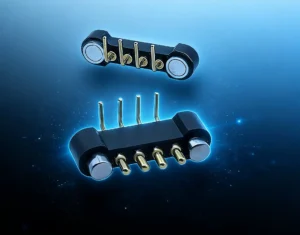
Magnetic pogo pin interfaces can support automated production lines where
robotic tool changers, fixtures, AGV docks and removable automation modules
require repeated electrical connection. However, reliable production
depends on more than magnetic attachment. Engineers should define mechanical
seating, pogo pin working stroke, contact sequencing, power-enable logic,
signal references, contamination limits and connection-health monitoring.
The goal is not simply to make contact, but to detect degrading connection
conditions before they become production-line downtime.
Why Connector Faults Become Production-Line Faults
Automated production equipment increasingly depends on removable electrical
interfaces.
Robotic end effectors may exchange tooling, AGVs may dock to charging or
material-handling stations, fixtures may move between process cells, and
sensor or vision modules may be replaced during maintenance.
In each case, the connector becomes part of the machine sequence.
A connection that is mechanically attached but electrically unstable can
create problems such as:- tool-identification errors;
- intermittent sensor signals;
- unexpected PLC alarms;
- power-enable failures;
- communication faults;
- repeated docking attempts;
- unplanned machine stops.
For this reason, connector reliability should be treated as part of the
automation architecture rather than only as a component specification.
Where Magnetic Pogo Pin Interfaces Fit in Automation
| Automation Interface | Possible Connector Role | Primary Engineering Focus |
|---|---|---|
| Robotic Tool Changer | Power, detection, control and project-specific signals | Repeatable seating, sequencing and cycle durability |
| AGV / AMR Dock | Charging, detection or service connection | Position tolerance, contamination and docking state |
| Production Fixture | Sensor, actuator and identification interface | Repeatability and rapid fixture replacement |
| Inspection Module | Power, trigger and project-specific data paths | Signal reference and mechanical alignment |
| Replaceable Process Head | Power, control, ID and interlock | Power sequencing and safe module removal |
| Maintenance Fixture | Diagnostics, programming or test connection | Repeatability and service access |
These are application examples rather than fixed Pin Maps. The electrical
interface should be developed from the actual automation function.
A Tool Change Is an Electrical State Machine
Automatic tool change should not be treated as a single mechanical event.A controlled interface may move through several states:
    Tool Approaches
    →
    Mechanical Guidance
    →
    Magnetic Capture
    →
    Final Seating
    →
    Tool Detection
    →
    Tool Identification
    →
    Signal Validation
    →
    Power Enable
    →
    Production State


During tool removal, the process should move through a controlled reverse
sequence.

The important engineering principle is:


    Magnetic attachment should not automatically mean that the machine is
    ready to energize or start production.
Magnetic Capture Is Only One Stage of Tool Alignment
Magnets can help bring two connector halves together, but they should not
correct the complete positioning error of a robot or automatic tool
changer.| Alignment Function | Recommended Design Control |
|---|---|
| Robot / Tool Approach | Machine motion and position control |
| Coarse Mechanical Alignment | Guide pins, tapered surfaces or tool-changer geometry |
| Residual Alignment | Floating or compliant connector mounting where appropriate |
| Final Capture | Magnetic arrangement |
| Electrical Alignment | Connector housing and mating-target geometry |
| Working Stroke | Mechanical stops and dimensional tolerance stack |
Pogo Pins Should Not Carry Tool-Changer Structural Loads
Spring-loaded contacts are primarily electrical components.

The robot or tool-changing mechanism should carry process loads, impact,
torque and structural forces through dedicated mechanical features.
A preferred load path is:
    Tool
    →
    Mechanical Coupling
    →
    Tool-Changer Structure
    →
    Robot
rather than:
    Tool
    →
    Pogo Pin Plunger
    →
    Spring
    →
    PCB / Connector Termination


Separating the mechanical and electrical load paths can help maintain
repeatable contact geometry across frequent tool changes.
Working Stroke Is Part of Machine Repeatability
Every pogo pin should remain inside its approved working-compression range
after the tool or module reaches its final seated position.
A simplified relationship is:
S = Hfree - Hseatedwhere:
- S is actual pogo pin compression;
- Hfree is installed free contact height;
- Hseated is final target distance.
The complete tolerance stack may include:
- pogo pin free-height variation;
- mating-target height;
- target flatness;
- tool-changer repeatability;
- connector mounting position;
- PCB position;
- mechanical-stop position;
- wear in the mechanical coupling.
| Stroke Condition | Possible Production Effect |
|---|---|
| Insufficient Compression | Intermittent contact or unstable resistance |
| Approved Working Stroke | Intended contact-force and electrical state |
| Excessive Compression | Spring bottoming, target wear or excessive structural load |
| Unequal Compression | Different resistance across a multi-contact array |
Make-First / Break-Last Requires a Complete Control Strategy
Different contact heights can be used to create a project-specific mating
sequence.

A longer detection or reference contact may engage before another contact,
but the mechanical sequence alone does not ensure electrical safety.
A possible sequence is:
    Reference / Detection
    →
    Tool Presence Confirmed
    →
    Tool ID Checked
    →
    Interlock Validated
    →
    Main Power Enabled
    →
    Process Operation


During separation, power should be removed according to the system design
before power contacts physically disconnect.
A Pilot Contact Does Not Suppress an Arc
A pilot or detection contact provides state information to the machine
controller.

It does not physically extinguish an arc by itself.

Arc prevention depends on the PLC, safety circuit, relay, contactor or
switching electronics removing the relevant current before separation.

Therefore:


    Contact sequencing provides information; the control system manages
    power.
Sequencing Must Be Tested Under Misalignment
Staggered contact heights may behave differently if the module approaches
at an angle.
Validation should include:
- nominal straight mating;
- maximum permitted lateral offset;
- maximum angular offset;
- slow engagement;
- fast engagement;
- partial engagement;
- one obstructed contact;
- one contaminated target;
- worn mechanical-guide conditions where applicable.
A sequence that works during closely perpendicular bench testing should
not automatically be assumed to remain valid after repeated machine use.
EMI Is a System Architecture Problem
Servo drives, motors, welding equipment, switching power electronics and
industrial networks can create a challenging electromagnetic environment.

A magnetic pogo pin connector does not independently eliminate EMI or
supports error-free communication.
System performance may depend on:
- signal type;
- signal voltage;
- data rate;
- contact layout;
- reference and return paths;
- shield termination;
- chassis bonding;
- PCB routing;
- cable architecture;
- motor and power-cable separation;
- filtering and protection components.
A Metal Housing Is Not Automatically an EMI Shield
A conductive connector housing can contribute to a shielding strategy,
but simply placing metal around the contacts does not ensure effective
shielding.
Shielding performance may depend on:
- housing electrical continuity;
- gaps and apertures;
- connection to equipment chassis;
- shield-contact sequence;
- mating-state continuity;
- frequency range;
- PCB reference structure;
- cable-shield termination.
EMC performance should therefore be validated on the complete machine,
module or relevant equipment configuration.
Separate Power, Control and Sensitive Signals Intentionally
A robotic tool interface may need to carry several electrical domains
through one connector.| Electrical Domain | Primary Design Consideration |
|---|---|
| Power | Current, voltage drop, temperature rise and switching state |
| Sensor Signals | Reference path and noise sensitivity |
| Digital Communication | Return path, transition geometry and complete channel |
| Detection / ID | State during partial mating |
| Interlock | Safe machine state before power enable |
| Shield / Chassis | Equipment grounding and EMC strategy |
Additional spacing, dedicated return contacts or separate connector groups
may be useful where noisy power circuits and sensitive signals should not
share the same dense contact region.
IO-Link Compatibility Is Not Defined by the Connector
A pogo pin interface can provide conductive paths used by an IO-Link device
or another industrial communication system.

However, the connector itself does not become “IO-Link compatible” merely
because sufficient contacts are available.

Protocol performance depends on the complete electronics, transceiver,
reference path, PCB routing, cable structure and channel validation.

The same principle applies to other project-specific industrial
communication interfaces.
Contact Wiping Is Not the Same as Self-Cleaning
Some pogo pin tip and target geometries may generate limited relative
movement during mating.

That movement can disturb certain light surface films, but it should not
be described as guaranteed self-cleaning.

Industrial contamination can include:- cutting-fluid residue;
- grease;
- metal particles;
- abrasive dust;
- coolant residue;
- oxidation or corrosion products.
Some contaminants may actually increase wear when trapped between the pogo
pin and mating target.
Contamination Should Be Reproduced During Validation
A connector tested only in a clean laboratory may behave differently on an
operating production line.
Representative testing may include:
- defined contamination type;
- defined contamination quantity;
- contact resistance before exposure;
- contact resistance after exposure;
- working-stroke behaviour;
- module-seating behaviour;
- contact-surface wear;
- cleaning procedure and recovery.
Washdown Protection Must Include the Complete Interface
Industrial equipment can encounter cleaning water, coolant, oils and other
liquids, but an IP-rated pogo pin component does not automatically make the
complete machine interface washdown resistant.
The sealing boundary may include:
- pogo pin feedthrough;
- connector housing;
- housing-to-machine joint;
- gaskets;
- potting or insert molding;
- cable or wire entry;
- PCB termination;
- drainage paths.
Mated, partially mated and unmated states may also have different
environmental behaviour.
Connector Condition Can Become a Maintenance Signal
One important opportunity in automated production equipment is to monitor
connection behaviour over time instead of waiting for a complete failure.

Depending on the machine architecture, useful indicators may include:- voltage drop across a power connection;
- connector or termination temperature;
- number of docking retries;
- tool-identification errors;
- interlock failures;
- communication retries;
- cycle count;
- maintenance inspection results.
None of these indicators alone proves that a pogo pin is failing.
However, trends can provide useful information for maintenance decisions.
Voltage Drop Can Be Used as a Contact-Health Indicator
For a defined current path, an increase in measured voltage drop can
indicate an increase in total electrical resistance.
A simplified relationship is:
Vdrop = I × Rpath

However, interpreting the result requires knowledge of current, temperature
and the rest of the conductor path.

A higher voltage drop should therefore be treated as a diagnostic signal
that requires additional investigation rather than automatic proof of
connector wear.
Temperature Trend Can Reveal Local Connection Problems
Increased resistance in a power contact or termination can produce
additional heating under load.
The resistive loss can be represented as:
Ploss = I² × Rpath

Temperature monitoring can be useful for power interfaces, but sensor
placement should represent the expected contact or termination hot spot.

A sensor mounted far away from the electrical interface may respond too
slowly to a localized resistance increase.
Docking Retries Are Also Useful Diagnostic Data
Not every connector problem appears first as electrical resistance.

A machine that begins requiring multiple docking attempts may be showing
early signs of:- mechanical-guide wear;
- connector contamination;
- target damage;
- magnetic debris;
- mounting-position drift;
- reduced pogo pin movement;
- incorrect module seating.
Tracking docking attempts can therefore provide useful maintenance context
alongside electrical measurements.
Design Diagnostics Around Failure Modes
| Observed Machine Condition | Possible Connector-Related Cause | Useful Diagnostic Check |
|---|---|---|
| Tool Not Detected | Detection contact not engaged | Check seating, working stroke and detection circuit |
| Intermittent Sensor Value | Unstable signal contact or reference | Inspect contact condition and complete signal path |
| Repeated Communication Fault | Contact, routing, reference or EMC problem | Separate connector diagnosis from complete-channel analysis |
| Power Interface Runs Hot | Higher path resistance or insufficient compression | Measure voltage drop, current and temperature |
| Multiple Docking Attempts | Mechanical or contamination issue | Inspect guides, targets and connector movement |
| Fault Appears After Many Cycles | Wear, contamination or mechanical drift | Compare current condition with baseline measurements |
Predictive Maintenance Requires a Baseline
Contact-health monitoring becomes more useful when measurements are compared
against a known initial condition.
A production system may record:
- initial voltage drop;
- initial connector temperature under defined load;
- normal docking time;
- normal number of docking attempts;
- cycle count;
- communication-error baseline.
Future measurements can then be compared with the baseline to identify
trends.

This does not mean the connector can independently predict its remaining
life. Maintenance thresholds must be established using actual machine data
and validated failure criteria.
Cycle Count Alone Should Not Trigger Connector Replacement
Two connectors with the same number of mating cycles can experience very
different wear depending on:- working stroke;
- side loading;
- contamination;
- electrical load;
- vibration;
- temperature;
- cleaning procedures;
- mechanical alignment.
Cycle count is useful maintenance information, but it should be combined
with actual electrical and mechanical condition data.
Design for Fast Fault Isolation
In automated manufacturing, repair time can matter as much as component
life.

The interface should therefore be designed so maintenance personnel can
quickly determine whether a fault originates from:- the pogo pin connector;
- the mating target;
- the mechanical tool changer;
- the PCB or wiring;
- the PLC input or output;
- the communication channel;
- the connected tool or module.
Accessible diagnostics and modular replacement can reduce troubleshooting
complexity even when they do not change the underlying component lifetime.
Do Not Assume a Magnetic Interface Is Always Better Than a Circular Connector
Conventional threaded, bayonet, rectangular and industrial circular
connectors remain appropriate for many automation systems.
A magnetic pogo pin architecture is more attractive when the project requires:
- frequent automated mating;
- low insertion force;
- blind mating;
- controlled breakaway;
- a shallow contact interface;
- automated module or tool replacement.
A different connector architecture may be preferable when:
- positive mechanical locking is required;
- the interface is rarely disconnected;
- very high contact density is required;
- a standardized industrial cable ecosystem is needed;
- the process environment cannot support exposed contact surfaces;
- the electrical requirements exceed the validated capability of the proposed pogo pin array.
Automated Production Line Connector Selection Parameters
| Parameter | Engineering Definition |
|---|---|
| Application | Tool changer, AGV dock, fixture, process module or service interface |
| Pin Count | Number of independent electrical paths |
| Pin Map | Power, return, detection, control, interlock and signal allocation |
| Working Stroke | Minimum, nominal and maximum pogo pin compression |
| Contact Force | Specify at the intended working stroke |
| Mating Target | Target dimensions, material, finish and flatness |
| Docking Tolerance | Maximum allowable lateral and angular mating error |
| Mechanical Load | Load carried by the tool changer rather than the contacts |
| Continuous Current | Confirm using complete-path voltage-drop and temperature-rise testing |
| Signal Requirements | Project-specific protocol, voltage and data characteristics |
| Contamination | Oil, coolant, dust, metallic debris or process residue |
| Environmental Protection | Define the required mated and unmated exposure conditions |
| Cycle Requirement | Define using actual stroke, alignment and electrical conditions |
| Diagnostic Requirement | Voltage, temperature, connection state, retry or communication monitoring |
Recommended Validation Matrix
| Validation Area | Recommended Evaluation |
|---|---|
| Mechanical Approach | Evaluate minimum, nominal and maximum alignment conditions |
| Working Stroke | Measure compression across the complete array |
| Contact Sequencing | Evaluate normal, angled and partial mating |
| Power Enable | Verify valid detection and interlock state before energization |
| Voltage Drop | Measure the complete intended power path |
| Temperature Rise | Evaluate under representative current and ambient conditions |
| Communication | Validate the complete electrical channel in the intended machine environment |
| EMC | Evaluate relevant machine or equipment configuration |
| Contamination | Test representative process fluids, dust and debris |
| Repeated Tool Change | Monitor resistance, working stroke, surface wear and docking behaviour |
| Fault Detection | Confirm the controller identifies defined abnormal connection states |
| Maintenance Recovery | Verify inspection, cleaning and replacement procedures |
Information Required for Engineering Review
| Project Input | Information to Provide |
|---|---|
| Automation Application | Robot tool changer, AGV, fixture, inspection head or another removable module |
| Pin Map | Function of every required contact |
| Electrical Conditions | Voltage, continuous current and peak current |
| Signal Requirements | Signal type, voltage, data rate and project-specific protocol |
| Tool-Change Sequence | Mechanical seating, detection, interlock and power-enable order |
| Working Stroke | Minimum, nominal and maximum pogo pin compression |
| Alignment Tolerance | Maximum lateral and angular mating error |
| Cycle Requirement | Expected connection frequency and maintenance interval |
| Environment | Coolant, oil, dust, metal debris, cleaning and temperature conditions |
| Diagnostic Requirement | Required voltage, temperature, ID, retry or fault monitoring |
| Project Files | 2D drawing, 3D assembly, PCB layout, wiring diagram or PLC sequence |
Frequently Asked Questions
Why use magnetic pogo pins in automated production lines?
They can support repeated removable electrical connections where robotic
tooling, fixtures, AGVs or process modules need low-insertion-force or
blind-mate interfaces.
Can magnetic pogo pins reduce production downtime?
They can support architectures designed for rapid automated connection and
modular replacement, but total downtime depends on the complete machine,
connector condition, diagnostics, maintenance process and failure modes.
Can magnetic pogo pins eliminate EMI?
No. EMC performance depends on the complete electrical architecture,
including signal references, shielding, grounding, PCB routing, cable
structure and nearby noise sources.
Does a metal connector housing block factory-floor EMI?
Not automatically. A conductive housing can contribute to shielding only
when continuity, chassis bonding, apertures and shield termination are
appropriately designed.
Can magnetic pogo pin connectors support IO-Link?
They can provide project-specific conductive paths used by an IO-Link
system, but protocol compatibility depends on the complete electronics,
routing and channel implementation rather than the connector alone.
Are pogo pin connectors self-cleaning?
No. Some contact geometries may create limited wiping action, but oils,
metal particles, abrasive dust and process residue require representative
contamination testing and maintenance planning.
Can pogo pins prevent arcing during automatic tool change?
Not by themselves. Detection or pilot contacts can provide state
information, while the machine controller and switching devices must remove
current before the relevant power contacts separate.
How can connector degradation be detected before a line stop?
Depending on the system, engineers can monitor trends such as voltage drop,
connector temperature, docking retries, identification errors,
communication retries and inspection results. Thresholds must be developed
from the actual machine and validated failure behaviour.
Does a high mating-cycle rating supports long production-line life?
No. Service life also depends on working stroke, alignment, contamination,
electrical load, vibration, temperature and maintenance conditions.
What information is needed for a custom automation connector?
Provide the automation application, Pin Map, voltage, current, signal
requirements, tool-change sequence, working stroke, alignment tolerance,
contamination conditions, expected cycle frequency and mechanical or
electrical drawings.
Request an Automated Production Line Connector Engineering Review
Explore

    custom magnetic connector solutions

for robotic tooling, fixtures, automated docking and removable industrial
modules.

Review

    pogo pin and spring-contact solutions

for project-specific PCB and machine interfaces.

Submit the Pin Map, tool-change sequence, electrical requirements,
working stroke, environmental conditions and project drawings through the

    Get Quote & Samples page
.


    CTP can review contact layout, pogo pin working stroke, mating targets,
    magnetic capture, contact sequencing, PCB, FPC or wire termination and
    connection-monitoring requirements for custom automated production-line
    interfaces. Final cycle life, signal performance, EMC behaviour,
    environmental protection and equipment availability depend on the
    complete customer machine and project-specific validation.
CTP ENGINEERING PATHS
Choose the right path for your project
Move from application requirements to a connector pair, a data-capable cable assembly, or a charging cable configuration. Final specifications are confirmed against an approved drawing and project validation plan.
Magnetic Connectors
Connector geometry, pin layout, mechanical integration and OEM/ODM review.
Engineering overview → 02Magnetic Data Cables
Power and signal allocation, cable exit, interface selection and assembly review.
Cable engineering → 03Magnetic Charging Cables
Browse the complete cable catalog and shortlist a starting structure for customization.
View cable catalog →