A serviceable dock is easier to plan before its enclosure is closed. Once the contact board is soldered deep inside a sealed housing, replacing a worn interface may involve much more than changing a small connector. The useful decision is where the product’s replaceable boundary should sit.
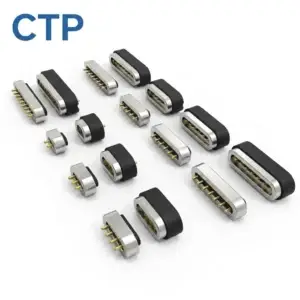
In a replaceable contact module vs fixed contacts comparison, a removable assembly makes sense when service access, identification and reconnection can be designed into the product. Fixed contacts can be the simpler choice where they are well supported and rarely need attention. CTP supplies housed contact blocks, individual spring contacts and mounting-ear magnetic pairs that can be integrated into either approach; a catalogued part is not automatically a ready-made service cartridge.
A replaceable contact module needs a route out of the enclosure
Start with the technician’s access. Can the cover be opened? Can the contact assembly be removed without disturbing another board? Is there enough room to reach its termination? If the answer depends on bending a cable aside or lifting a soldered board, the service concept is not yet complete.
For a charging dock with an accessible rear cover, a small connector carrier may be a practical product-design option. The carrier can establish the position while a defined electrical termination reconnects it to the dock. That surrounding carrier, fastening and service process must be designed for the application.
A ten-contact housed assembly keeps its contact pattern together
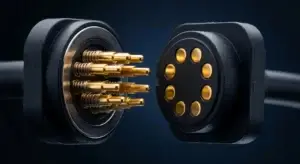
Our ten-contact pogo pin assembly, catalogue reference CTP-P3897, brings ten spring-loaded contacts into a controlled housing. It contains no magnets. It is a useful building block to discuss where a multi-channel interface should remain one identifiable assembly within a removable carrier.
The advantage is keeping the contact positions coordinated. A service team does not need to identify ten unrelated loose pins if the project is designed around replacement of the housed block. Whether the block can actually be removed, and how its electrical paths reconnect, still belongs to the selected termination and carrier design.
A five-contact molded housing can suit a smaller service boundary
The CTP five-contact molded-housing assembly, CTP-P3881, offers another contact count and physical outline. It can be reviewed for a compact device whose approved circuit needs fewer paths and whose surrounding structure already supplies alignment and retention.
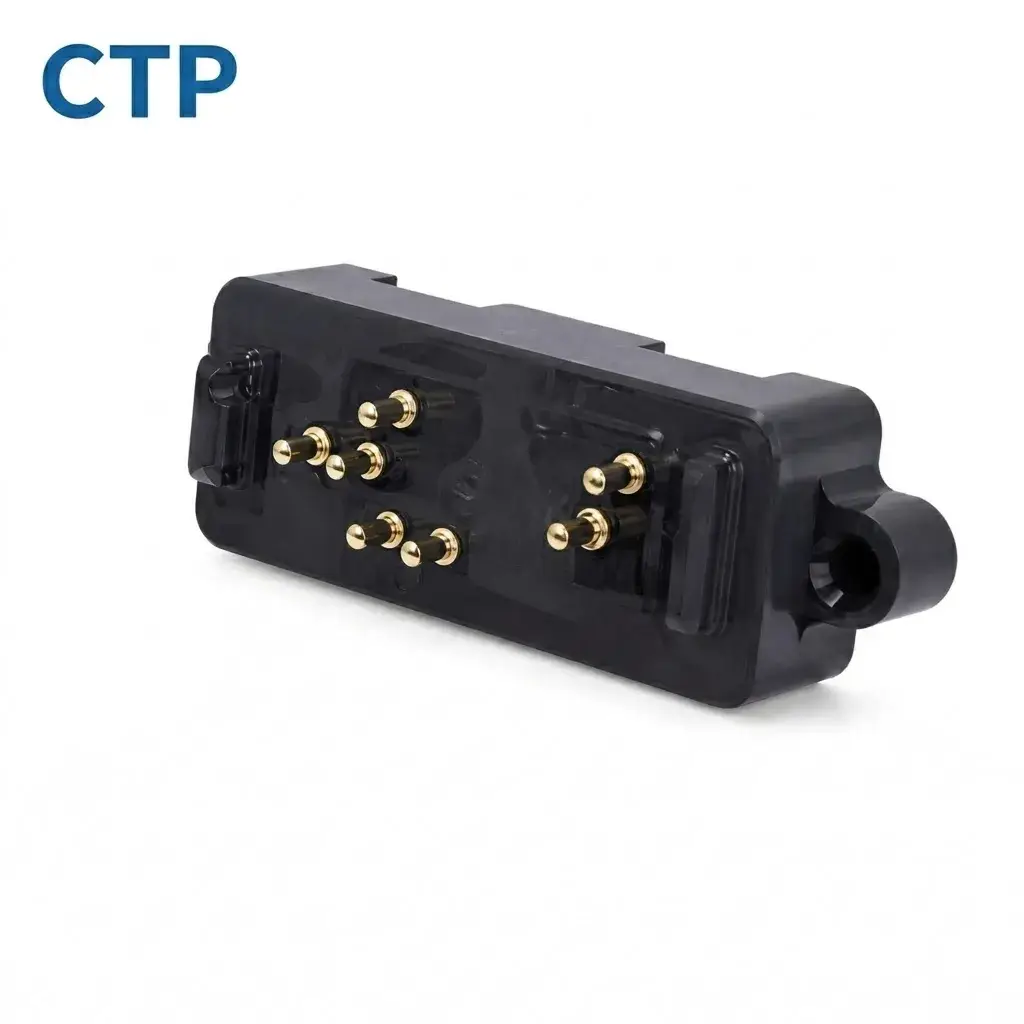
For a removable sensing accessory, the smaller contact block may fit a service opening more naturally than a larger array. The choice should follow the circuit and the available access, rather than a desire to call every small connector a replaceable module.
Fixed contacts can be a sensible part of a controlled assembly
A contact that remains fixed in the product can avoid an additional service connector or carrier. That may suit a compact, low-complexity device in which the interface is well protected and the product’s normal service route does not require contact-level replacement.
A double-ended pin can connect two facing surfaces inside a carrier
Our double-ended spring contact, CTP-PP-1P-DE-A01, provides contact interfaces at both ends for a project-defined compression arrangement. It offers a different architecture from a contact block permanently terminated on one side.
For example, a small carrier could retain individual double-ended contacts between a board and removable module. The carrier and stops must establish their position and available travel. Replacing the carrier may be possible in a suitable product design, but that is not a universal service feature of the loose pin itself.
In a fixed internal connection, the same contact format may simply bridge two surfaces that are rarely separated. The useful question is how the completed assembly supports the pin and limits compression, not whether an individual component looks easy to pull out.
Mounting ears make a different replacement boundary possible
The CTP two-contact magnetic connector with mounting ears, CTP-MPC-2P-SR-MB-A01, gives the mechanical designer defined housing attachment points. Its magnetic elements assist mating while the spring-loaded contacts provide the electrical interface.
This can be attractive for a dock whose receiver should attach to an accessible panel. The ears and fastening arrangement can be considered as part of that panel assembly. The cable or board termination behind it must also be reachable if the receiver is intended to be replaced later.
A second project may have no suitable panel access at all. In that case, calling the receiver replaceable can create an expectation the housing cannot meet. A fixed assembly, serviced at a larger product boundary, may be the more honest and practical choice.
Define the replacement item before placing a repeat order
As a custom connector manufacturer, CTP can review the contact layout, housing and termination around the intended service route. Our connector identity and traceability article explains why the selected part needs a clear definition when a replacement is ordered.
For a removable contact assembly, identify the complete item: contact block, carrier if supplied, mating target and electrical termination. Keep the drawing revision with that definition. A replacement that fits the opening but has a different contact allocation is not an interchangeable service part.
Before closing the rear cover, make the contact-block orientation easy to recognise from the service side. A clear carrier feature and matching drawing view can save a technician from turning a five-contact assembly around simply because its outline looks symmetrical.
The best choice is the one your product can support in practice. If access is available and the service boundary is clear, a removable module can make maintenance more manageable. If access is deliberately limited, use a well-defined fixed connection and state the larger assembly that is actually intended to be replaced.