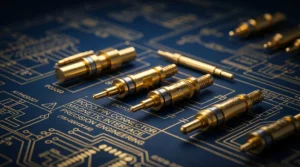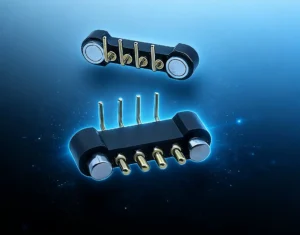
Comparing pogo pin manufacturers starts with a decision about what you need to buy: an individual spring-loaded contact, a housed multi-pin connector, or a complete magnetic connector and cable interface. These are different sourcing tasks. A supplier’s catalog current rating or cycle-life figure cannot automatically be applied to a different contact geometry, housing or assembly.
This guide separates catalog selection from custom interface development. It provides a practical evidence checklist for procurement and engineering teams, without claiming that one manufacturer is universally best. For a China-focused shortlist, see the separate magnetic pogo pin supplier evaluation guide.
Choose the Product Architecture Before the Manufacturer
| What you need | What to request | Common qualification gap |
|---|---|---|
| Individual pogo pin | Part-number drawing, working stroke, mounting method and contact-force data | Comparing free height instead of compressed operating height |
| Pogo pin connector assembly | Housing geometry, pitch, pin count, PCB or wire termination and mating target | Assuming every pin in the array has the same electrical function |
| Magnetic connector pair | Both mating halves, alignment features, polarity and separation requirements | Evaluating only the spring contact rather than the complete interface |
| Magnetic charging or data cable | Connector pair, cable construction, pin map, termination and strain relief | Treating a USB-shaped end as proof of a supported data protocol |
Catalog Sources to Check Directly
The following are examples of public manufacturer catalogs, not a league table. Check the current source and the exact part number before selecting a component. Inclusion does not imply affiliation, endorsement or drop-in interchangeability with CTP products.
Mill-Max: Spring-Loaded Contact and Connector Catalog
The Mill-Max product finder includes a spring-loaded contacts and connectors family. Use the manufacturer’s part-number information and drawings when evaluating a catalog contact. A similar appearance alone is not sufficient for approving an alternative.
PRECI-DIP: Spring-Loaded Contacts and Connectors
PRECI-DIP’s spring-loaded contact page describes its contact designs and links to product examples. Its product finder separates contact and connector families. Confirm which specific design and termination match your assembly rather than transferring one series’ published data to another.
CTP: Custom Pogo Pin, Connector and Magnetic Cable Projects
CTP’s published range covers individual pogo pins, pogo pin connector assemblies, magnetic connectors and magnetic cable assemblies. Catalog pages identify configurations; the approved project drawing controls custom dimensions and requirements.
Review the CTP certificate and engineering evidence page. A management-system certificate or a photograph of test equipment is useful for supplier due diligence, but neither is a product-specific test report. Request model-specific evidence before accepting a current, sealing, lifecycle or signal-performance claim.
Send Every Supplier the Same Interface Brief
Price comparisons become misleading when one quote includes the housing and mating target while another includes only loose contacts. Give each supplier the same controlled specification and ask them to identify assumptions separately. Start with:
- Required contact count and the function of every contact.
- Available envelope, mating direction and mechanical datums.
- Minimum and maximum compressed heights across the tolerance stack.
- Continuous and peak electrical load, duty cycle and allowable temperature rise.
- Signal protocol and its validation method, if data transfer is required.
- Cable length, end termination and strain-relief conditions where applicable.
- Environment, mating profile, sample quantity and expected production demand.
Do not specify only a maximum stroke. Ask how the contact operates at the minimum and maximum assembly compression. Likewise, define whether an environmental requirement applies while mated, unmated or installed in the final device.
Distinguish a Reference Value from a Verified Result
| Evidence | What it can support | What to verify next |
|---|---|---|
| Published catalog value | A reference for the identified catalog configuration | Applicability to your drawing revision and operating conditions |
| Dimension drawing | The stated geometry and tolerances for that drawing | Mating compatibility, revision control and installation stack-up |
| Sample measurement | The recorded sample and measurement conditions | Sample size, equipment calibration, acceptance criteria and repeatability |
| Lifecycle or environmental report | The tested assembly under the stated procedure | Load, stroke, mating target, environment and end-of-test limits |
| Management-system certificate | The certified organization, scope and validity period | Whether the manufacturing site and activity match the proposed supply route |
Approve Samples Before Approving Production
A useful sample review follows the full assembly, not just the loose pin. Confirm dimensional fit, contact engagement at tolerance limits and the intended pin map. Evaluate cable routing and strain relief when the connector is supplied as an assembly. Record the drawing revision, sample identity, conditions, equipment and acceptance decision so the next production lot can be compared against the same basis.
If an alternate supplier is proposed, review it as a new qualification unless interchangeability has been demonstrated. Equivalent pitch and pin count do not establish equivalent stroke, contact force, housing datum, plating or signal behavior.
Clarify Tooling, Changes and Supply Responsibilities
Before placing a production order, document who owns custom tooling, who approves drawing changes and how substitutions are controlled. Ask which processes are performed by the supplier and which are subcontracted. Define lot traceability and the evidence required for first-article or pilot approval. Delivery timing should be confirmed against the actual design, tooling and validation plan, not a generic promise.
Frequently Asked Sourcing Questions
Is a magnetic pogo pin connector the same as an individual pogo pin?
No. The spring-loaded contact is one component. A magnetic interface also depends on the housing, mating target, magnets and installation geometry. Qualify the assembled interface.
Can a published current rating prove fast-charging compatibility?
No. Current capacity and protocol compatibility are separate requirements. Specify the load and the required protocol, then agree how each will be validated.
Can one supplier be called the best for every project?
A catalog component, a test probe and a custom cable assembly have different requirements. Select on documented project fit and qualification evidence rather than a generic ranking.
Request a CTP Project Review
Send the connector SKU or reference, drawing or sketch, pin map, available space, electrical load and expected quantities through the quote and sample request form, or contact bella@ytanpogo.com. CTP can review the proposed configuration; final custom values remain subject to the approved drawing and agreed validation conditions.