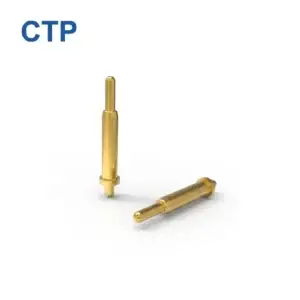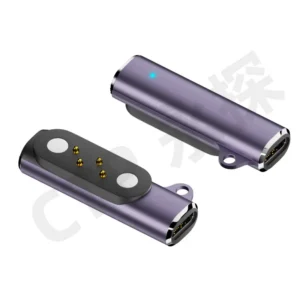
A miniature magnetic pogo pin interface can support charging, docking, device identification and service functions in a hearing aid, but miniaturization cannot be evaluated from pogo pin diameter alone. The complete design must coordinate the hearing-aid format, contact location, charging cradle, working stroke, magnetic capture, earwax and moisture exposure, surface treatment, user handling and final device validation.
Hearing aids place unusually demanding constraints on a charging interface. The connector must share a limited enclosure with the battery, microphones, receiver, antenna, signal-processing electronics, acoustic openings and mechanical supports.At the same time, the product may be handled by users who find very small devices difficult to grip or align. The charging contacts may also be exposed to perspiration, skin oils, earwax, dust, cleaning residue and repeated insertion into a charging case.
A magnetic pogo pin interface may help simplify the final docking movement, while spring-loaded contacts compensate for a defined amount of dimensional variation. However, the connector should not be selected only by its external diameter, magnetic force or coating name.
Engineers who need the general system architecture can first review the
spring-loaded magnetic connector architecture guide
.Hearing Aid Format Determines the Charging Interface
The term “hearing aid connector” does not describe one universal structure. Behind-the-ear, receiver-in-canal, in-the-ear and completely-in-canal products provide different space, handling and contamination conditions.| Hearing Aid Format | Typical Packaging Condition | Charging Interface Questions |
|---|---|---|
| Behind-the-ear (BTE) | Most electronics are located in a housing behind the ear | Can the contact area be positioned on the lower housing, battery section or charging cradle without interfering with the ear hook or tubing? |
| Receiver-in-canal (RIC) | Electronics remain behind the ear while a receiver wire enters the canal | How do the receiver wire, battery, antenna and charging contact compete for internal space? |
| In-the-ear (ITE) | The electronics are integrated into a custom shell in the outer ear | Can the charging surface remain accessible without creating pressure points or interfering with microphones and controls? |
| In-the-canal (ITC) | The device occupies part of the ear canal and has a reduced external surface | Where can the contacts be placed so they remain accessible but do not collect excessive earwax? |
| Completely-in-canal (CIC) | The device is deeply positioned and has very limited volume and gripping area | Can the charging and removal workflow be completed without requiring precise manual alignment or excessive handling force? |
The smaller the hearing aid becomes, the more important it is to evaluate the charging case, removal tool, user grip area and complete device geometry together.

A miniature connector does not automatically create a smaller product. The magnets, insulating housing, soldering area, PCB support, target pads, mechanical stops and sealing structure may require more volume than the visible pogo pin.
Start with the Charging Architecture
A hearing aid may use several charging or service architectures.| Architecture | How It Works | Primary Engineering Focus |
|---|---|---|
| Charging case with pogo pins | Spring-loaded contacts are installed in the case and mate with flat targets on the hearing aid | Case alignment, left-right orientation, contact compression and case contamination |
| Charging cradle with device-side pogo pins | The hearing aid contains the spring-loaded contacts and the dock provides targets | Exposed pin protection, cleaning access and device-side internal depth |
| Magnetic charging cable | A removable cable attaches to contacts on the hearing aid | Cable weight, accidental pulling, small-device movement and user handling |
| Programming or service fixture | Temporary contacts connect the hearing aid to production or fitting equipment | Fixture repeatability, service access and separation from consumer charging contacts |
| Contactless charging | Energy transfers without exposed conductive charging contacts | Coil space, thermal behavior, alignment, efficiency and system cost |
In many miniature products, placing the spring-loaded contacts in the charging case and using flat targets on the hearing aid can reduce the number of moving components exposed on the wearable device.

This is not automatically the correct solution. The final choice depends on internal space, replaceability, cleaning, service strategy and the required electrical path.
Allocate a Complete Packaging Budget
The visible contact surface is only one part of the charging interface. The internal space must be allocated before the hearing-aid shell and PCB layout are frozen.| Packaging Area | Why It Matters | Possible Conflict |
|---|---|---|
| External mating surface | Determines target-pad size, contact spacing and cleaning access | Microphone openings, receiver outlets, controls and cosmetic surfaces |
| Internal connector depth | Contains the pogo pin, housing, magnet or electrical termination | Battery, antenna, PCB and acoustic components |
| PCB connection area | Provides solder pads, traces and mechanical support | Signal-processing components and battery connection |
| Magnet position | Affects capture direction, retention and charging-case layout | Telecoil, magnetic sensors, receiver, antenna and enclosure fasteners |
| Mechanical stop | Controls final pogo pin compression | Thin shell walls and limited cradle depth |
| Cleaning clearance | Allows removal of earwax, dust and residue | Recessed decorative features and narrow charging slots |
Moving the charging interface late in the design process may affect the shell, battery, PCB, acoustic path, antenna and charging-case mold.Do Not Design Only Around Pogo Pin Diameter
A very small pogo pin may appear attractive for a CIC or ITC device, but diameter alone does not determine whether the final interface is practical.Miniature contact design must consider:
- Free height
- Total mechanical travel
- Approved working stroke
- Spring force at minimum and maximum compression
- Tip geometry
- Barrel and plunger tolerances
- Housing-wall thickness
- Contact spacing
- PCB attachment area
- Target-pad dimensions
- Assembly and inspection capability
Reducing diameter or height can also reduce available spring travel, mechanical robustness, conductor area and assembly margin.| Miniaturization Decision | Possible Benefit | Trade-Off to Review |
|---|---|---|
| Reduce contact diameter | Smaller visible interface | Current path, mechanical tolerance and manufacturing capability |
| Reduce total height | Less internal depth | Shorter working stroke and lower tolerance compensation |
| Reduce contact spacing | More compact Pin Map | Contamination bridging, electrical isolation and assembly variation |
| Reduce target size | Smaller external contact area | Less tolerance for charging-case offset |
| Use stronger magnets | Greater capture or retention | Higher seating impact, removal force and nearby-component interaction |
Control the Working Stroke Through the Charging Case
The pogo pin working stroke is the compression applied after the hearing aid reaches its final seated position in the charging case.The tolerance stack may include:
- Pogo pin free-height tolerance
- Pin mounting position
- Charging-case insert dimensions
- Hearing-aid shell dimensions
- Target-pad height and flatness
- Left and right charging-slot variation
- Case hinge and lid pressure
- Device orientation
- Debris trapped below the hearing aid
- Housing or PCB deflection
Minimum, nominal and maximum compression should all remain within the approved working range.| Condition | Possible Result |
|---|---|
| Insufficient compression | Unstable charging, false dock detection or intermittent contact |
| Excessive compression | High insertion force, contact damage, PCB load or spring bottoming |
| Uneven compression | Different contact forces and unequal current distribution |
| Contamination under the device | The hearing aid appears seated but does not reach the required contact position |
The charging case should provide the mechanical location and stop. Magnets should not be used to force the pogo pins into uncontrolled compression.Design for Users Who May Find Small Devices Difficult to Handle
CIC and ITC hearing aids can be difficult to grip, position and remove because of their small size. A charging interface should therefore be evaluated as a complete user task rather than only as a connector mating event.Review:
- Can the user distinguish the left and right device?
- Can the hearing aid be placed in the wrong charging slot?
- Must the user rotate the device precisely?
- Can the device be inserted with reduced finger dexterity?
- Can the user remove it without pulling on a microphone opening or receiver wire?
- Does the charging indicator clearly confirm electrical connection?
- Can the device remain magnetically captured without actually charging?
- Can a carer clean the contacts without special tools?
| User Expectation | Engineering Translation |
|---|---|
| Easy placement | Defined approach region and charging-case guides |
| Automatic orientation | Mechanical coding, asymmetric geometry or validated magnetic arrangement |
| Clear charging confirmation | Full-seating detection and visible or audible feedback |
| Easy removal | Accessible grip area and controlled retention force |
| Left-right prevention | Different slot geometry, identification logic or both |
For a broader review of body-worn charging routines, charging-case behavior and user interaction, continue to the

    smart wearable magnetic charging application guide
.
Earwax, Perspiration and Organic Residue Are Different Contaminants
Ear-worn devices may encounter several types of contamination. They should not be represented by one generic “waterproof” requirement.| Exposure | Possible Effect on the Interface | Required Project Input |
|---|---|---|
| Earwax | Surface coverage, incomplete seating, increased resistance and difficult cleaning | Contact position, likely accumulation area and cleaning method |
| Perspiration | Electrolytic residue, corrosion and leakage between nearby contacts | Wear duration, exercise use and customer-defined exposure condition |
| Skin oils | Film formation, dust retention and variation in contact behavior | Body-contact position and cleaning frequency |
| Cosmetics or personal-care products | Polymer, coating or marking degradation | Expected product types and exposure frequency |
| Cleaning agents | Surface discoloration, swelling, corrosion or adhesive damage | Agent, concentration, application method and number of cycles |
| Dust and lint | Blocked charging slot or uneven contact compression | Storage case, pocket use and inspection interval |
The contact location should be selected with the likely contamination path in mind. A recessed position may protect the contacts from accidental touch but can also trap earwax and make cleaning difficult.

A flat accessible target may be easier to inspect, but it can remain exposed during use. The correct geometry balances protection, drainage, cleaning access and charging alignment.
Separate Device Sealing from Exposed Contact Performance
A hearing aid can use exposed electrical targets while still sealing the internal enclosure, but these are two different engineering requirements.The protection boundary may include:
- Insert-molded target contacts
- Contact-to-shell interface
- Adhesive or potting
- Shell joints
- Microphone and receiver openings
- Battery and service interfaces
- Charging-case contacts
An ingress-protection claim should identify the complete tested device, its mating state, enclosure configuration and test condition.

Passing an ingress test does not prove resistance to earwax, perspiration, disinfectants, cosmetics or long-term contact corrosion.
Nano-Coating Is a Process Description, Not a Performance Guarantee
“Nano-coating” can refer to several different materials and deposition processes. It does not identify electrical conductivity, corrosion resistance, wear behavior, biological safety or long-term durability by itself.Before specifying a coating, define:
- Coating material
- Deposition process
- Nominal thickness and tolerance
- Substrate and underlying plating
- Areas that are coated
- Areas that must remain electrically exposed
- Adhesion requirement
- Permitted porosity or defect level
- Wear and abrasion behavior
- Post-coating contact resistance
- Cleaning and chemical exposure
ALD Oxide Films Require Special Caution on Contact Areas
Atomic Layer Deposition can form thin and conformal films. However, commonly discussed ALD materials such as aluminum oxide and titanium oxide may act as dielectric or insulating layers.

Applying an insulating film continuously across the electrical mating zone cannot be assumed to preserve a low-resistance contact.
Possible development approaches include:
- Coating only non-contact surfaces
- Masking the electrical contact zone
- Using a selectively patterned coating
- Choosing another contact-compatible surface treatment
- Designing the contact motion to reach an approved conductive surface
- Validating the coating after representative wear and contamination
Do not claim that a 10–50 nm oxide coating is “conductively transparent.” Electrical contact performance depends on the actual film chemistry, continuity, contact pressure, surface deformation and wear mechanism.
Do Not Assume a Coating Is Self-Cleaning
A high water-contact angle does not prove that earwax, skin oil or mixed organic residue will roll away from a hearing-aid contact.

Earwax is not equivalent to clean water, and the charging interface may remain horizontal or recessed rather than positioned for liquid runoff.

Any self-cleaning statement should be supported by testing with representative contamination, geometry, temperature and cleaning conditions.
Contact Plating Must Be Evaluated as a Layer System
Contact performance depends on the substrate, underlayer, finish, thickness, hardness, porosity and mating mechanics.

A statement such as “pure gold,” “hard gold” or “nickel-free” does not provide enough information for engineering review.| Layer-System Question | Why It Matters |
|---|---|
| What is the base material? | It affects conductivity, strength, formability and corrosion behavior |
| Is there an underlayer? | It may influence diffusion, adhesion and exposure after wear |
| What is the contact finish? | It affects wear, oxidation, friction and contact stability |
| What is the coating thickness? | It affects available wear margin but cannot be evaluated without the mating conditions |
| How does the contact move? | Axial compression, sliding and wiping create different wear patterns |
| What happens after the finish is damaged? | The underlayer or substrate may become exposed to moisture and contamination |
Do Not Use Contact Resistance to Claim Better Sound Quality
The charging contacts usually form part of the power path rather than the acoustic signal path. Even where the interface carries programming or electrical data, contact resistance alone does not determine hearing-aid sound quality.Hearing performance may depend on:
- Microphones
- Receiver
- Amplification and signal processing
- Feedback control
- Fitting parameters
- Acoustic coupling to the ear
- Wireless or electrical input
- Battery and power stability
- Complete electromagnetic environment
The connector should be evaluated for its defined electrical function. It should not be described as producing “pure sound” or preventing audio distortion unless the complete hearing-aid performance has been tested.Define the Charging Electrical Path
The complete charging path may include:
- External power adapter
- Charging-case power circuit
- Charging-case PCB
- Spring-loaded contacts
- Hearing-aid target pads
- Device-side PCB
- Battery-charging circuit
- Rechargeable battery
- Firmware and charging indication
Define:
- Charging voltage
- Continuous and peak current
- Permitted voltage drop
- Permitted temperature rise
- Source-side contact state while the case is empty
- Short-circuit behavior
- Foreign-object exposure
- Left-right device identification
- Partial-mating behavior
- Charging timeout and fault indication
The Pogo Pin provides the conductive path. Voltage regulation, battery management and charging safety belong to the complete electrical system.Left and Right Devices Require a Defined Error Strategy
A charging case may contain separate slots for the left and right hearing aids. The system should define what happens when:- The devices are placed in the wrong slots
- Only one device is installed
- One device is rotated
- A foreign object bridges contacts
- The device is present but not fully seated
- One charging contact is contaminated
- The case lid applies uneven pressure
Possible controls include:
- Different left-right cradle geometry
- Asymmetric target layouts
- Mechanical keys
- Electrical identification
- Independent charging channels
- Full-seating detection
- Fault indication
Magnetic polarity alone should not be assumed to eliminate all orientation and wrong-slot conditions.Review Permanent Magnets Around Hearing-Aid Components
Magnets used for charging alignment should be evaluated together with the complete hearing aid.Review their relationship to:
- Telecoil where present
- Receiver
- Microphones
- Magnetic sensors
- Wireless antennas
- Battery
- Internal magnetic fasteners
- Charging-case lid magnets
The correct magnet is not automatically the strongest one. The design should provide enough capture and seated retention without disturbing nearby functions or making device removal unnecessarily difficult.Biological Evaluation Depends on Accessible Materials
Not every internal charging contact has the same body-contact profile.

The hearing-aid manufacturer should determine:- Which connector materials are externally accessible
- Whether they contact skin or the ear canal
- Contact duration and frequency
- Whether wear exposes an underlayer
- Whether coating particles or corrosion products can be released
- Whether cleaning residue remains on the interface
- Whether the charging case contacts are user-accessible
“Medical grade,” “nickel-free,” “titanium” or “pure gold” should not be used as a substitute for biological evaluation of the final material system and intended contact.Hearing-Aid Performance and Connector Validation Are Different
Connector validation should demonstrate that the interface performs its assigned electrical and mechanical functions.

Hearing-aid electroacoustic performance, electromagnetic immunity and user benefit require separate device-level evaluations.| Evaluation Area | Primary Question |
|---|---|
| Connector electrical performance | Does the charging or service path maintain the required resistance and voltage? |
| Connector mechanical performance | Does the interface reach the correct position and working stroke? |
| Hearing-aid electroacoustic performance | Does the complete device meet its defined acoustic characteristics? |
| Hearing-aid EMC performance | Does the complete hearing aid continue functioning under the applicable electromagnetic conditions? |
| User performance | Can intended users charge, remove, clean and identify the device correctly? |
When May a Magnetic Pogo Pin Interface Be Appropriate?
| Project Requirement | Possible Value |
|---|---|
| Repeated charging-case docking | Spring-loaded contacts can compensate for a defined dimensional range |
| Limited user dexterity | Magnetic capture may simplify the final positioning movement |
| Custom hearing-aid shell | The target-pad and cradle geometry can follow the product shape |
| Separate left and right devices | Contact layouts can support identification and independent charging |
| Accessible charging surface | Flat targets may simplify inspection and cleaning |
| Programming or service access | Spring-loaded contacts can provide a temporary non-consumer interface |
When May Another Charging Interface Be More Appropriate?
Another architecture may be preferable when the project requires:
- No exposed conductive contacts
- Very high resistance to organic contamination
- No permanent magnets near sensitive components
- A fully standardized charging accessory
- Extremely limited target-pad area
- A replaceable primary battery rather than rechargeable operation
- Contactless charging as a core product requirement
- Minimal custom tooling and development
Magnetic Pogo Pin charging should be selected because it solves a defined packaging or usability problem, not because it is assumed to be universally better for every hearing-aid format.Recommended Validation Plan
| Requirement | Possible Evaluation |
|---|---|
| Packaging | Connector, shell, PCB, battery, acoustic components and charging-case dimensional review |
| Working stroke | Minimum, nominal and maximum compression in both charging slots |
| Mating behavior | Approach, magnetic capture, mechanical seating and device removal |
| Partial mating | Offset, tilted, one-contact-first and magnetically captured but unseated conditions |
| Electrical path | Contact resistance, voltage drop and temperature rise |
| Charging control | Short circuit, foreign object, wrong slot, charging timeout and fault indication |
| Earwax exposure | Representative contamination, seating, cleaning and post-cleaning operation |
| Perspiration and residue | Customer-defined exposure followed by corrosion and electrical inspection |
| Coating performance | Thickness, adhesion, contact resistance, wear and post-exposure analysis |
| Repeated docking | Project-defined charging cycles with mechanical and electrical checks |
| User handling | Placement, left-right identification, removal and charging confirmation |
| Device sealing | Complete hearing-aid enclosure under the defined test state |
| Device performance | Electroacoustic and EMC verification on the final hearing aid |
Information Required for an Engineering Review
| Requirement Group | Information to Provide |
|---|---|
| Hearing-aid format | BTE, RIC, ITE, ITC, CIC or another device structure |
| Interface purpose | Charging, docking, identification, programming or service |
| Available space | External contact area, internal depth and complete section drawing |
| Pin Map | Power, return, detection, identification and service contacts |
| Electrical conditions | Voltage, continuous current, peak current and charging control |
| Mechanical | Approach direction, charging-case geometry, stops and removal method |
| Magnetic behavior | Required capture, seated retention and intentional removal force |
| Contamination | Earwax, perspiration, skin oils, dust and cleaning conditions |
| Coating | Material, process, coated zones, thickness and performance objective |
| Body contact | Accessible materials, contact type, duration and frequency |
| Device components | Battery, microphone, receiver, telecoil, antenna and restricted areas |
| Files | 2D drawing, 3D model, PCB layout, charging-case model and assembly information |
| Commercial | Prototype quantity, production forecast and project stage |
Common Engineering Mistakes
| Mistake | Possible Consequence | Better Approach |
|---|---|---|
| Selecting only by pogo pin diameter | The complete connector cannot fit or lacks sufficient working stroke | Evaluate the housing, PCB, target and charging case together |
| Calling every thin coating a nano-protection solution | Electrical, wear and corrosion behavior remain undefined | Specify the coating material, process, location and validation method |
| Applying an insulating oxide across the mating surface | Contact resistance may increase or become unstable | Use selective coating, masking or a contact-compatible finish |
| Assuming a high contact angle removes earwax | Organic contamination remains trapped on the interface | Test representative residue and cleaning procedures |
| Maximizing magnetic force | Device removal becomes difficult and nearby components may be affected | Balance capture, retention and user-removal force |
| Assuming magnetic capture proves charging | The device is held in place without reaching the correct working stroke | Use mechanical stops and independent charging confirmation |
| Using contact resistance to claim sound quality | The complete electroacoustic system is ignored | Separate charging-contact tests from hearing-aid performance tests |
| Calling gold or titanium automatically biocompatible | The final body-contact material system is not evaluated | Apply a risk-based biological evaluation |
| Claiming universal life improvement | The statement is not tied to a tested device or exposure profile | Report the tested part, cycle, contamination and acceptance criteria |
Engineering Reference Sources
Applicable standard editions, product requirements and acceptance criteria should be confirmed for the final hearing-aid project.-
FDA — Types and physical formats of hearing aids
-
NIDCD — Hearing-aid styles, size and handling considerations
-
IEC 60118-0:2022 — Measurement of hearing-aid performance characteristics
-
IEC 60118-13:2019 — Hearing-aid immunity to mobile digital wireless devices
-
IEC 60601-2-66:2019 — Basic safety and essential performance of hearing aids and hearing-aid systems
-
ISO 14971:2019 — Medical-device risk management
-
ISO 10993-1:2025 — Biological safety evaluation within risk management
-
Corrosion failure analysis of hearing-aid battery spring contacts
Frequently Asked Questions
Are magnetic pogo pins suitable for every hearing aid?
No. Suitability depends on the hearing-aid format, available space, charging architecture, contamination exposure, user handling and nearby components.Can magnetic pogo pins be used in CIC hearing aids?
A miniature interface may be evaluated, but the complete connector housing, target area, internal termination and charging-case tolerance must fit the available volume.Does a nano-coating automatically prevent corrosion?
No. Performance depends on the coating chemistry, thickness, continuity, substrate, wear, contamination and the areas that are coated.Can ALD aluminum oxide be applied directly over the electrical contact?
Aluminum oxide is commonly used as an insulating dielectric. Applying it continuously over a mating contact cannot be assumed to preserve a low-resistance connection without a specific contact design and validation.Does a hydrophobic coating remove earwax?
Not automatically. Earwax and skin oils behave differently from clean water. Representative contamination and cleaning tests are required.Does low contact resistance improve hearing-aid sound quality?
Low and stable resistance may support the assigned charging or electrical function, but hearing quality depends on the complete acoustic and signal-processing system.Should stronger magnets be used in miniature hearing aids?
Not automatically. Magnetic force must be balanced against removal effort, seating impact, device size and interaction with nearby components.Can an IP-rated hearing aid resist perspiration and earwax?
An ingress rating does not by itself establish chemical, organic-contamination or long-term corrosion resistance.How should left and right hearing aids be distinguished in a charging case?
The design may combine different cradle geometry, asymmetric contacts, identification circuits and independent charging confirmation.What information is required for a custom hearing-aid connector review?
Provide the hearing-aid format, available dimensions, Pin Map, electrical conditions, charging-case geometry, contamination profile, coating requirement, body-contact information and available drawings.Prepare Your Hearing Aid Charging Interface Project
Review the

    custom magnetic connector catalog

for current structures.

When the correct pin count and connector structure remain uncertain, use the

    magnetic pogo pin connector selection guide
.

Submit the hearing-aid format, charging-case model, Pin Map, available space and contamination requirements through the

    Get Quote & Samples page
.


    CTP can review the connector supply scope, miniature contact layout, pogo pin working stroke, mating targets, magnetic arrangement, PCB termination and charging-case interface. Final coating performance, biological safety, hearing-aid performance, EMC, charging safety and regulatory compliance must be confirmed for the complete customer device.
CTP ENGINEERING PATHS
Choose the right path for your project
Move from application requirements to a connector pair, a data-capable cable assembly, or a charging cable configuration. Final specifications are confirmed against an approved drawing and project validation plan.
Magnetic Connectors
Connector geometry, pin layout, mechanical integration and OEM/ODM review.
Engineering overview → 02Magnetic Data Cables
Power and signal allocation, cable exit, interface selection and assembly review.
Cable engineering → 03Magnetic Charging Cables
Browse the complete cable catalog and shortlist a starting structure for customization.
View cable catalog →