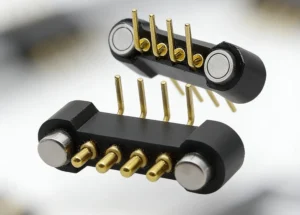
Engineering Summary:
A magnetic pogo pin connector can form an electrical interface between a reusable electronics module, a disposable patient-contact patch, a charging dock or a production fixture. It does not independently supports ECG accuracy, pulse-oximetry performance, glucose measurement accuracy, continuous remote data delivery or medical-device compliance. The complete design must coordinate the sensing architecture, body-contact boundary, mechanical flexibility, charging state, contact allocation, contamination, usability and device-level risk controls.
A magnetic pogo pin connector can form an electrical interface between a reusable electronics module, a disposable patient-contact patch, a charging dock or a production fixture. It does not independently supports ECG accuracy, pulse-oximetry performance, glucose measurement accuracy, continuous remote data delivery or medical-device compliance. The complete design must coordinate the sensing architecture, body-contact boundary, mechanical flexibility, charging state, contact allocation, contamination, usability and device-level risk controls.
Remote patient monitoring patches may combine physiological sensors, electrodes, optical components, motion sensing, local processing, wireless communication and a power source inside a compact skin-worn device.The physical connector becomes relevant when one part of the system must be removable, rechargeable, reusable, programmable or replaceable. A project may, for example, separate a disposable adhesive and sensing layer from a reusable electronics pod, or use exposed targets only when the reusable module is placed in a charging dock.
These architectures create different electrical and mechanical requirements. The first engineering question is therefore not “How many pogo pins are required?” It is “Which parts of the health-patch system must connect, disconnect or be reused?”
For the general construction and operating principles of the connector itself, review the
spring-loaded magnetic connector architecture guide
.Define the Connector’s Position in the RPM System
A remote patient monitoring system contains several functional layers. The magnetic connector normally belongs to one physical interface within this larger system.| System Layer | Primary Function | Possible Connector Role |
|---|---|---|
| Patient-contact layer | Electrodes, optical windows, sensor chemistry, adhesive and skin interface | May connect to a removable electronics module where the architecture permits |
| Reusable electronics module | Signal conditioning, processing, storage, power management and wireless communication | May mate with a disposable patch, charging dock or service fixture |
| Charging interface | Recharge the reusable module and confirm docked state | Provide power, return, detection and identification contacts |
| Service or production interface | Programming, calibration, testing and manufacturing diagnostics | Provide temporary spring-loaded electrical access |
| Wireless link | Transfer stored or real-time data to a phone, gateway or another device | Normally outside the passive connector function |
| Remote platform | Data storage, review, alerts, integration and clinical workflow | Outside the physical connector function |
Engineering Note:
A stable physical contact cannot prove that information was measured accurately, transmitted wirelessly, received by a server or reviewed by a clinician. These are separate system functions.
A stable physical contact cannot prove that information was measured accurately, transmitted wirelessly, received by a server or reviewed by a clinician. These are separate system functions.
Choose the Patch Architecture Before Designing the Connector
Multi-parameter health patches can use different product architectures. The connector should be developed around the selected architecture rather than copied from another wearable device.Architecture 1: Fully Disposable Patch
The sensing layer, electronics and battery are disposed of together after the intended wear period.

A consumer charging connector may not be required. Spring-loaded contacts may still be used for:- Production testing
- Firmware programming
- Battery activation
- Calibration
- Final functional inspection
In this architecture, adding magnets and a reusable charging interface may increase size, material cost and assembly complexity without providing user value.Architecture 2: Disposable Patient-Contact Layer with Reusable Electronics Pod
The adhesive, electrodes or other patient-contact elements are replaced while the electronics module is reused.

The module-to-patch interface may need to transfer:- Electrode signals
- Sensor power
- Sensor identification
- Temperature or motion signals
- Patch-presence detection
- Project-specific digital communication
This interface is mechanically challenging because it is located on or near a flexible body-worn structure. The connector must not transfer excessive load into the adhesive or create a rigid pressure point against the skin.Architecture 3: Sealed Reusable Patch with Separate Charging Dock
The complete patch is removed from the body and placed in a charging cradle.

The charging connector may only need:- Charging power
- Power return
- Dock detection
- Device identification
- Optional service or data contacts
In this architecture, the charging contacts do not necessarily carry physiological signals during normal wear.Architecture 4: Replaceable Sensor Cartridge and Reusable Transmitter
A sensing cartridge or patient-contact component connects to a reusable transmitter.

The connector must be reviewed together with the cartridge insertion path, sensing technology, replacement procedure, contamination boundary and correct-cartridge identification.
Separate the Wear State from the Charging State
A remote monitoring patch may spend most of its operating life attached to the patient, while the connector may only be active during charging, module replacement or service.| Device State | Possible Connector Condition | Primary Engineering Question |
|---|---|---|
| Applied to patient | Module and patient-contact layer are connected | Does the interface remain stable during body movement without loading the skin or adhesive? |
| Monitoring | Signals, sensor power or identification may be active | What happens if one contact becomes intermittent? |
| Patch removed | Patient-contact layer or complete device is detached | Are exposed contacts energized or contaminated? |
| Module separated | Reusable module is removed from the disposable layer | How are stored data, power and sensor states handled? |
| Charging | Module mates with a dock or cable | How are full seating, current limiting and fault conditions detected? |
| Cleaning | Module or dock may be wiped or inspected | Which surfaces and chemicals are permitted? |
| Service or programming | Temporary contacts connect to a fixture | Can service contacts affect normal device operation? |
Where continuous monitoring is an essential product requirement, the design must define what happens during charging. Possible system strategies may include module replacement, sufficient battery duration, scheduled charging or another validated workflow.

The connector itself cannot ensure uninterrupted monitoring while the device is removed from the patient or placed in a charger.
Do Not Attribute Physiological Accuracy to the Connector Alone
Multi-parameter patches may include ECG, temperature, motion, optical sensing or other measurement functions. Each measurement has its own sensing and validation chain.ECG Monitoring
The ECG signal path may include:- Skin preparation and electrode contact
- Electrode material and geometry
- Patient movement
- Lead arrangement
- Input protection
- Analog front end
- Filtering and sampling
- Artifact handling
- Processing and analysis
- Storage and wireless transmission
A connector may be part of this path when a reusable electronics module connects to disposable electrodes. Stable electrical continuity is important, but low contact resistance alone cannot prove ECG waveform accuracy, ST-segment performance or diagnostic suitability.Optical Heart Rate or Pulse Oximetry
Optical performance may depend on:- Emitter wavelength and drive
- Detector performance
- Optical path
- Skin contact
- Ambient-light rejection
- Motion artifact
- Perfusion
- Signal processing
- Calibration and validation
The connector may provide power or digital communication between modules, but it cannot independently supports oxygen-saturation accuracy.Continuous Glucose Monitoring
Glucose measurement performance may depend on the sensing chemistry, tissue interaction, calibration strategy, temperature compensation, signal processing and the complete sensor system.

A pogo pin connector cannot be credited with reducing glucose measurement error from one percentage to another unless a documented device-level study directly supports that conclusion.
Temperature and Motion
Temperature measurement can be affected by sensor location, skin coupling, ambient conditions, heat from electronics and algorithms. Motion measurement depends on sensor placement, mechanical attachment and processing.

The connector should only be described as maintaining its assigned power or signal path under the defined conditions.
Decide Whether Raw or Digitized Signals Cross the Interface
The location of signal conditioning affects the connector requirements.| Interface Strategy | Potential Benefit | Primary Trade-Off |
|---|---|---|
| Raw analog signal crosses the connector | Simpler disposable sensing layer | Greater sensitivity to return paths, noise, movement and contact disturbance |
| Signal conditioning near the sensor | Shorter low-level analog path | More components and power on the disposable or patient-contact layer |
| Digitized data crosses the connector | Potentially more robust interface between modules | Requires protocol, power, timing and identification design |
| Wireless connection between modules | Eliminates some physical signal contacts | Adds radio, power, coexistence and cybersecurity requirements |
The choice should be made from the complete system architecture, not from the assumption that a larger number of pogo pins automatically supports more medical parameters.Develop the Pin Map from Independent Functions
The required contact count should be derived after all independent electrical functions are listed.| Possible Contact Function | Questions to Define |
|---|---|
| Power | What voltage, current, duty cycle and start-up behavior are required? |
| Power return | What return path exists during every credible contact state? |
| Analog signal | What signal level, source impedance, bandwidth and reference are required? |
| Digital communication | What physical layer, data rate, topology and protection apply? |
| Patch detection | Does the contact indicate initial presence or a valid final connection? |
| Patch identification | Must the module identify sensor type, lot, expiry or configuration? |
| Power enable | What condition authorizes power to the sensor or charging interface? |
| Shield or reference | How is it separated from power return and patient-connected circuitry? |
| Service function | Is programming or manufacturing access required? |
When the appropriate contact count or connector structure remains uncertain, continue to the

    magnetic pogo pin connector selection guide
.
A Skin-Worn Patch Is a Moving Mechanical Platform
A connector installed in a rigid laboratory fixture behaves differently from one attached to a flexible patch on the human body.

Body movement may produce:- Patch bending
- Torsion
- Repeated local compression
- Skin stretching
- Adhesive peel
- Module rocking
- Clothing contact
- Impact while sleeping
These movements should not be translated directly into the pogo pins, solder joints or patient-contact electrodes.Separate Structural Loads from Electrical Contact
The housing or module attachment should carry the primary mechanical load.A preferred load path is:
Reusable module → mechanical attachment → patch structure → adhesive arearather than:
Reusable module → magnets → pogo pins → electrodes or flexible circuit

Spring-loaded contacts should compensate for a controlled dimensional range. They should not act as the main fastener holding a heavy electronics pod against a flexible patient-contact patch.
Magnetic Retention Must Be Balanced Against Adhesive Peel
A stronger magnetic connection may make the module feel secure, but it can also increase the force required to separate the reusable electronics from the disposable patch.

If the user removes the module while the patch is still attached to the skin, excessive retention may:- Peel the adhesive unexpectedly
- Pull the skin
- Disturb the electrodes
- Damage the flexible circuit
- Cause the entire patch to detach
Define separately:- Magnetic capture force
- Normal module retention
- Removal direction
- User grip area
- Maximum load transferred to the adhesive
- Behavior during clothing contact or sleep
- Whether the module may be removed while the patch remains on the body
Engineering Note:
The strongest magnet is not automatically the safest or most usable choice for a skin-mounted device.
The strongest magnet is not automatically the safest or most usable choice for a skin-mounted device.
Control the Working Stroke Across a Flexible Assembly
Pogo pin compression must remain within the approved range despite variation in the reusable module, disposable patch and patient-contact structure.The tolerance stack may include:
- Pogo pin free height
- Connector mounting height
- Module housing dimensions
- Patch housing or carrier thickness
- Flexible-circuit position
- Mating-target flatness
- Mechanical-stop position
- Adhesive thickness
- Patch curvature on the body
- Housing deflection
- Contamination trapped at the interface
| Compression Condition | Possible Effect |
|---|---|
| Below minimum working stroke | Intermittent contact, false patch detection or unstable power |
| Nominal working stroke | Intended electrical and mechanical state |
| Above maximum working stroke | Excess reaction force, contact damage or flexible-circuit loading |
| Uneven compression | Different contact forces and possible current or signal imbalance |
A defined mechanical stop should establish the final position. Magnetic attraction should not force the pogo pins into uncontrolled compression.Charging Is a Separate Electrical Mode
When the reusable module is placed in a charging dock, the connector becomes part of a different electrical system from the patient-monitoring state.The charging path may include:
- External adapter or charging source
- Charging-dock power circuit
- Dock PCB or cable
- Spring-loaded contacts
- Module target pads
- Device-side protection
- Battery-management circuit
- Rechargeable cell
- Firmware and charging indication
Define:
- Charging voltage
- Continuous and peak current
- Input capacitance
- Permitted voltage drop
- Permitted temperature rise
- Short-circuit behavior
- Foreign-object detection where required
- Contact state when the dock is empty
- Charging authorization
- Timeout and fault indication
- Removal during charging
The pogo pin creates the contact path. It does not independently regulate battery charging or establish medical electrical safety.Partial Mating Must Be Treated as a Real Device State
Magnetic capture does not prove that the module or charging interface has reached full seating.| Condition | Possible Risk | Required Review |
|---|---|---|
| One edge connects first | The actual contact sequence differs from the nominal design | Approach angle, housing guides and earliest contact position |
| One contact touches first | A signal or supply may be present without its intended return | Pin-height and target-position tolerance |
| Lateral offset | A power contact reaches an adjacent signal or conductive feature | Target dimensions, spacing and credible offset envelope |
| Magnetically retained but unseated | False patch or dock detection | Independent full-seating confirmation |
| Contamination between surfaces | Uneven compression or contact bridging | Cleaning access, spacing and diagnostics |
| Separation under load | Transient behavior, data interruption or incomplete shutdown | Power removal and system recovery |
Mechanical keys, asymmetric target layouts, identification contacts, current limiting and full-seating detection may be combined according to the risk analysis.Sweat, Skin Oil and Adhesive Residue Are Different Exposures
A body-worn patch may be exposed to a mixture of moisture, salts, oils, cosmetics, fibres and adhesive residue.| Exposure | Possible Interface Effect | Required Project Input |
|---|---|---|
| Perspiration | Electrolytic residue, corrosion and leakage between contacts | Wear duration, activity level and defined exposure method |
| Skin oil | Surface film, dust retention and variable contact behavior | Contact position and cleaning frequency |
| Adhesive residue | Incomplete seating or obstruction of mating targets | Module-removal and patch-disposal workflow |
| Body lotion or cosmetics | Material, coating or adhesive degradation | Foreseeable products and exposure frequency |
| Dust and fibres | Uneven compression and insulation changes | Clothing contact, storage and maintenance conditions |
| Cleaning agent | Discoloration, swelling, corrosion or adhesive damage | Agent, concentration, application method and cycles |
A generic salt-spray or ingress test does not reproduce every combination of sweat, skin oil, adhesive and body movement.Showering Is a Complete Device Requirement
Where the intended use permits showering or another water exposure, the complete wearable device must be evaluated in that state.

The protection boundary may include:- Patient-contact patch layers
- Reusable module housing
- Module-to-patch interface
- Contact inserts
- Adhesive or gasket structures
- Sensor openings
- Pressure-equalization features
- Charging or service contacts
An IP rating on one connector component does not prove that the complete patch can be worn in a shower. It also does not establish sweat, detergent, body-oil or adhesive compatibility.Patient Contact Must Be Evaluated from Accessible Materials
The biological evaluation depends on which materials directly or indirectly contact the body, the nature of that contact and its duration.Review:
- Patient-contact adhesive
- Electrode materials
- Patch carrier and films
- Externally accessible target contacts
- Connector housing
- Wear particles
- Corrosion products
- Coating or plating exposure after wear
- Manufacturing residues
- Cleaning residues
A connector described as gold-plated, nickel-free or medical grade is not automatically biologically safe for seven-day or fourteen-day skin contact.

Biological evaluation should be based on the final material system, manufacturing process, exposure and intended use.
Design for Patients and Caregivers at Home
Remote monitoring products may be applied, charged or replaced by patients, family members or caregivers without specialist equipment.Relevant usability questions include:
- Can the user identify the correct patch and reusable module?
- Can the module be attached in the wrong orientation?
- Does magnetic capture create a false impression of full connection?
- Can users with reduced dexterity remove the module without peeling the patch?
- Is charging confirmation clear?
- Can the user accidentally reuse a disposable component?
- Can contamination be seen and removed?
- What happens if the user charges the wrong module?
- How does the device communicate loss of skin contact or sensor connection?
- Can the user continue the monitoring workflow after an error?
| User Expectation | Engineering Translation |
|---|---|
| Easy module attachment | Defined approach region, guides and orientation control |
| Clear connection confirmation | Independent seated-state detection and visible, audible or app feedback |
| Easy module removal | Grip feature and controlled removal direction |
| Correct patch use | Mechanical coding, electronic identification or both |
| Clear charging state | Charging indication, fault reporting and completion status |
| Safe error recovery | Instructions and device behavior after partial mating or data interruption |
Physical Connection, Wireless Data and Cybersecurity Are Separate
A pogo pin connector may support local charging, identification or wired data. Remote patient monitoring usually also depends on wireless communication, software and a remote platform.| Requirement | Possible Connector Contribution | System Responsibility |
|---|---|---|
| Electrical continuity | Maintain the assigned contact path | Fault detection and recovery |
| Sensor-module identification | Provide identification contacts | Validate and authorize the component |
| Local data transfer | Provide a project-specific physical channel | Protocol, integrity checking and data handling |
| Wireless communication | No inherent function in a passive connector | Radio, antenna, coexistence and communication software |
| Remote data delivery | No inherent function in a passive connector | Phone, gateway, network and cloud platform |
| Cybersecurity | No inherent security in a passive electrical contact | Hardware, firmware, software and lifecycle controls |
A proprietary connector may reduce accidental attachment of an ordinary cable, but physical incompatibility should not be presented as cybersecurity or data authentication.Application Architecture Matrix
| Patch Function | Possible Connector Role | Primary Engineering Focus |
|---|---|---|
| Ambulatory ECG patch | Connect reusable recorder to disposable electrodes or provide charging and service access | Electrode signal path, movement artifact, patient-contact boundary and monitoring continuity |
| Temperature patch | Connect sensor layer to reusable electronics | Thermal path, body contact, calibration and self-heating |
| Optical monitoring patch | Provide module power, detection or digital communication | Optical geometry, motion, ambient light and skin contact |
| Motion and activity patch | Charging, identification or removable module interface | Mechanical attachment, orientation and body-motion transfer |
| Glucose-monitoring system | Possible transmitter-to-sensor or service interface depending on architecture | Sensor-system design, tissue interaction and complete measurement validation |
| Multi-parameter reusable module | Connect to different disposable sensing layers | Patch identification, wrong-patch prevention and channel allocation |
| Charging cradle | Power, return, dock detection and optional data | Full seating, foreign objects, exposed contacts and charging control |
When May a Magnetic Pogo Pin Interface Be Appropriate?
| Project Requirement | Possible Value |
|---|---|
| Reusable electronics with disposable patient-contact layer | Provides a compact removable electrical interface |
| Repeated charging | Spring-loaded contacts can compensate for a defined dock tolerance |
| Custom sensor Pin Map | Power, signals, identification and detection can be allocated for the project |
| Reduced manual alignment | Magnetic capture may assist final positioning |
| Flat reusable-module targets | Targets may simplify inspection and cleaning |
| Production or service testing | Spring-loaded contacts can provide temporary fixture access |
When May Another Interface Be More Appropriate?
Another architecture may be preferable when the product requires:
- A completely disposable device with no charging requirement
- No exposed conductive contacts
- Contactless charging
- A standardized medical accessory connection
- A qualified high-speed communication interface
- A positive mechanical lock that must not release
- Minimal rigid structure on the skin
- No magnets near sensitive components
- Long wear duration with high contamination exposure
Magnetic mating should be selected because it solves a defined modularity, charging or usability problem, not because it is assumed to improve every remote monitoring patch.Project-Specific Risk Review
| Potential Failure | Possible Effect | Design Questions |
|---|---|---|
| Reusable module detaches | Monitoring interruption or loss of stored data | Retention, alarms, storage and reconnection behavior |
| Module is difficult to remove | Adhesive peel, skin loading or patch damage | Removal direction, grip feature and magnetic force |
| Partial mating | False detection, unstable power or incorrect signal state | Guides, stops, detection and authorization |
| Wrong patch is attached | Incorrect configuration or measurement function | Mechanical coding, identification and software checks |
| Contact becomes contaminated | Resistance change, intermittent operation or bridging | Location, spacing, cleaning access and diagnostics |
| Charging contact is shorted | Heating, charging fault or power-source shutdown | Current limiting, exposed-contact state and foreign objects |
| Monitoring stops during charging | Gap in patient data | Battery duration, replacement workflow and user instructions |
| Wireless upload fails | Remote data is delayed or unavailable | Local storage, alerts and communication recovery |
| Body-contact material causes a reaction | Skin irritation or device discontinuation | Material characterization, exposure and biological evaluation |
Recommended Validation Plan
| Requirement | Possible Evaluation |
|---|---|
| System architecture | Disposable, reusable, charging, service and wireless boundaries |
| Mechanical fit | Module, patch carrier, flexible circuit, adhesive and enclosure dimensions |
| Working stroke | Minimum, nominal and maximum pogo pin compression |
| Body movement | Bending, torsion, sleep positions, clothing contact and representative activity |
| Module retention | Capture, normal retention, removal direction and adhesive load |
| Partial mating | Offset, tilted, one-contact-first and magnetically retained but unseated states |
| Electrical path | Contact resistance, voltage drop and temperature rise |
| Signal path | Noise, continuity and complete channel performance where applicable |
| Charging control | Short circuit, foreign object, inrush, timeout and removal under load |
| Perspiration and skin oil | Defined exposure followed by electrical and material inspection |
| Adhesive residue | Representative contamination, cleaning and remating |
| Water exposure | Complete device in the intended operating state |
| Repeated module replacement | Project-defined cycles with post-test inspection and measurement |
| Usability | Representative patients or caregivers applying, removing and charging the product |
| Biological safety | Accessible final materials, contact type and exposure duration |
| EMC | Complete medical device in representative operating modes |
| Wireless recovery | Local storage, reconnection, delayed upload and fault indication |
| Cybersecurity | Device and system lifecycle controls where connected functionality applies |
Sample configuration, severity, operating state and acceptance criteria should be defined from the intended use, applicable standards and device risk-management process.Information Required for an Engineering Review
| Requirement Group | Information to Provide |
|---|---|
| Patch architecture | Disposable, reusable, modular or charging-dock structure |
| Intended monitoring function | ECG, temperature, motion, optical sensing, glucose or another parameter |
| Interface location | Patient-contact layer, reusable module, charging dock or service fixture |
| Pin Map | Power, return, analog, digital, detection, identification and service functions |
| Electrical conditions | Voltage, continuous current, peak current, duty cycle and signal characteristics |
| Mechanical structure | Patch thickness, module dimensions, flexible circuit, attachment and removal direction |
| Magnetic behavior | Capture, retention, adhesive load and user-removal requirements |
| Wear profile | Body location, wear duration, activity, sleep and clothing interaction |
| Environment | Sweat, skin oil, lotion, water, dust and cleaning conditions |
| Body contact | Accessible materials, contact type, duration and frequency |
| Charging workflow | Charging frequency, monitoring interruption and user feedback |
| Communication | Wired or wireless physical layer, storage and recovery behavior |
| Compliance | Intended markets, applicable standards and performance criteria |
| Files | 2D drawings, 3D models, schematics, PCB layout, patch stack and charging-dock model |
| Commercial | Prototype quantity, disposable and reusable volumes, and project stage |
Common Engineering Mistakes
| Mistake | Possible Consequence | Better Approach |
|---|---|---|
| Calling the connector the last mile of RPM | The sensor, wireless, software and clinical workflow are ignored | Define the connector as one physical interface in the system |
| Using contact resistance to claim ECG accuracy | The complete physiological measurement chain is not evaluated | Validate the sensor-to-output system |
| Claiming reduced glucose error | Sensor chemistry and algorithms are incorrectly attributed to the connector | Limit connector claims to its assigned electrical function |
| Selecting a standard pin count first | Required detection, identification or return paths are omitted | Develop the Pin Map from independent functions |
| Maximizing magnetic force | The module peels the adhesive or loads the skin | Balance capture, retention and removal direction |
| Using pogo pins as structural fasteners | Flexible circuit, electrode or solder-joint damage | Provide a separate mechanical load path |
| Assuming magnetic capture proves full seating | False patch detection or unstable operation | Use stops and independent connection confirmation |
| Calling the connector waterproof | The claim is applied incorrectly to the complete skin-worn device | Validate the defined assembled patch state |
| Calling materials medically biocompatible | Final body contact and exposure are not assessed | Evaluate the final material system within risk management |
| Claiming zero data loss | Wireless, software and network failures are ignored | Define storage, recovery and communication behavior |
| Ignoring monitoring gaps during charging | The actual home-use workflow does not meet the intended monitoring period | Define battery, replacement and charging strategy |
Engineering Reference Sources
Applicable editions, particular standards and national requirements should be confirmed for the final device and intended monitoring function.-
FDA — Home Use Medical Devices
-
FDA — Wireless Medical Devices
-
IEC 60601-1 — Basic safety and essential performance of medical electrical equipment
-
IEC 60601-1-2 — Electromagnetic disturbances, requirements and tests
-
ISO 14971 — Medical-device risk management
-
IEC 62366-1 — Usability engineering for medical devices
-
ISO 10993-1 — Biological safety evaluation within risk management
-
IEC 60601-2-47 — Ambulatory electrocardiographic systems, where applicable
-
ISO 80601-2-61 — Pulse oximeter equipment, where applicable
-
FDA — Cybersecurity in Medical Devices
Frequently Asked Questions
Does a magnetic pogo pin connector make a health patch suitable for remote patient monitoring?
No. It may provide charging, module connection or service access, but remote monitoring also depends on sensors, processing, storage, wireless communication, software and clinical workflow.Can pogo pin connectors carry ECG signals?
They may carry project-defined analog or digital ECG-related signals, but suitability depends on the complete signal chain, patient-connected circuit, mechanical stability, EMC and device validation.Does low contact resistance supports accurate ECG data?
No. Electrode contact, motion artifact, analog electronics, filtering, sampling, processing and the complete system also affect the result.Can a connector improve continuous glucose-monitoring accuracy?
Stable continuity may support the assigned electrical interface, but glucose accuracy depends on the complete sensor and algorithm system. A numerical improvement should not be attributed to the connector without device-level evidence.Should the magnetic connector hold the complete patch on the skin?
Normally the patch carrier and adhesive should provide the patient attachment. The connector should not act as the primary structure carrying the complete body-worn device.Can a health patch be worn while showering?
Only when the complete assembled device has been designed and validated for that intended use. A connector-level IP claim is insufficient.Are gold-plated pogo pins automatically biocompatible?
No. Biological safety depends on the final materials, exposed surfaces, wear, manufacturing residues, contact type and exposure duration.Can magnetic capture confirm that the module is connected?
Not by itself. The module may be attracted magnetically without reaching the intended pogo pin compression. Independent seated-state detection may be required.What happens to monitoring while the module is charging?
That depends on the product architecture. The manufacturer must define battery duration, replacement, charging and data-gap handling according to the intended monitoring workflow.What information is required for a custom RPM patch connector review?
Provide the patch architecture, monitored parameters, interface location, Pin Map, electrical conditions, mechanical stack, body location, wear period, contamination, charging workflow and available drawings.Prepare Your Health-Patch Interface Project
Review the

    custom magnetic connector catalog

for existing connector structures.

Additional design resources are available through the

    CTP connector engineering guides
.

Submit the patch stack, reusable-module design, Pin Map, electrical conditions, charging workflow and available drawings through the

    Get Quote & Samples page
.


    CTP can review the connector supply scope, pogo pin layout, working stroke, mating targets, magnetic arrangement, flexible-circuit or PCB termination and charging-dock interface. Final physiological performance, patient-contact safety, EMC, wireless communication, cybersecurity and regulatory compliance must be confirmed for the complete medical device.
CTP ENGINEERING PATHS
Choose the right path for your project
Move from application requirements to a connector pair, a data-capable cable assembly, or a charging cable configuration. Final specifications are confirmed against an approved drawing and project validation plan.
01
Magnetic Connectors
Connector geometry, pin layout, mechanical integration and OEM/ODM review.
Engineering overview → 02Magnetic Data Cables
Power and signal allocation, cable exit, interface selection and assembly review.
Cable engineering → 03Magnetic Charging Cables
Browse the complete cable catalog and shortlist a starting structure for customization.
View cable catalog →