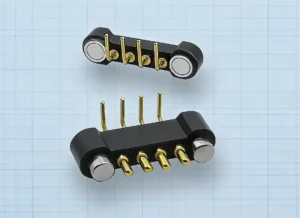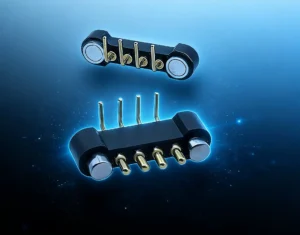
Custom magnetic connectors use embedded magnets to self-align two mating halves, while spring-loaded Pogo Pin contacts carry the electrical signal or power across the interface. They’re specified in place of a standard USB or micro-USB port whenever a device needs a higher-cycle-life, sealed, or user-friendly detachable connection; wearables, medical monitors, and industrial handhelds are the most common applications.
What Is a Custom Magnetic Connector?
A custom magnetic connector is an OEM/ODM-engineered mating interface where magnets provide alignment and retention, and spring-loaded contacts (Pogo Pins) provide the electrical path. Unlike an off-the-shelf connector, every parameter—Pin Map, pin count, current rating, magnetic retention force, housing geometry, and IP sealing—is defined around your device rather than fitted around a generic part.
How Does a Magnetic Pogo Pin Connector Work?
Two components do the work:
• Magnets pull the male and female halves into position automatically, so the user doesn’t need to align the connector by sight.
• Spring-loaded Pogo Pin contacts maintain constant contact pressure across the mating interface, keeping resistance low and stable even under vibration or slight misalignment.
This is why the part is often called a magnetic pogo pin connector: the magnetic force handles alignment and retention, while the pin’s spring force handles the electrical contact. Past a defined pull-force threshold, the connector releases cleanly—a break-away behavior widely specified for charging cables and wearable devices.
Why Specify a Magnetic Connector Instead of a Standard Port?
Longer cycle life. A standard USB-C or micro-USB port typically begins failing after 5,000–10,000 insertion cycles. A correctly engineered magnetic charging connector is commonly rated for 30,000–100,000+ mating cycles, since there’s no physical plug-and-socket wear.
Higher IP rating achievable. Without a cut port in the housing, IP67/IP68 sealing is significantly easier to achieve, a primary reason magnetic connectors dominate wearables, hearing aids, and electric-toothbrush charging docks.
Break-away safety. A yanked cable or an accidental trip detaches the connector cleanly instead of damaging the port or internal PCB.
Self-aligning UX. Magnetic self-alignment removes the need to find port orientation by sight, relevant for accessibility-driven products and low-light use cases.
Full customization. Pin count, current rating, housing material, and mechanical footprint are built around your space and electrical budget rather than an off-the-shelf shape.
Common Applications
Wearables & consumer electronics — smartwatches, fitness trackers, TWS earbuds, smart glasses, hearing aids
• Medical devices — portable patient monitors, ECG patches, equipment needing frequent, hygienic charging
• Industrial & test equipment — rugged handhelds, automated test fixtures
• Automotive & e-mobility — serviceable electrical interfaces on accessories and mobility equipment
• Smart home & IoT — modular, quick-swap sensor and device connections
See the full Application Engineering Examples for real project cases across these categories.
Briefing a Manufacturer: What to Send First
Before requesting a quote, have these ready — a manufacturer who asks for this information up front is pricing your actual part, not a placeholder:
• Application and operating environment
• Pin count and function allocation (Pin Map)
• Voltage, continuous current, and peak current
• Available installation space and mating direction
• Supply scope — connector component only, or a finished cable assembly
• Sealing/IP requirement, if applicable
• Any available 2D/3D drawings
For a full RFQ checklist and manufacturer-screening criteria, see our guide: How to Choose a Magnetic Connector Manufacturer.
Frequently Asked Questions
What’s the difference between a magnetic connector and a pogo pin connector?
A pogo pin connector uses spring-loaded pins for electrical contact but doesn’t necessarily include magnets. A magnetic pogo pin connector combines both: magnets for alignment/retention, pogo pins for the electrical path.
Can a custom magnetic connector carry both power and data?
Yes. Pin allocation is defined per project — a 4- or 5-pin connector, for example, can dedicate contacts to power, ground, and one or two data lines, as long as this is confirmed in the Pin Map before quoting.
What IP rating should I specify for a wearable device?
Most consumer wearables target IP67 or IP68 depending on whether the device is splash-resistant or fully submersible. The correct rating depends on the device’s actual use environment, not a default assumption.