Stroke remains the leading cause of adult disability globally, with approximately 80% of survivors experiencing limb movement disorders. Robot-Assisted Gait Training (RAGT) has emerged as a vital rehabilitation model, offering the high-intensity, repetitive tasks necessary for neural plasticity.
However, these complex wearable machines face a critical hurdle: maintaining stable electrical connections while the robot and the human body are in constant dynamic motion. Traditional connectors struggle with the high-frequency dynamic stress of joint movement, leading to contact fatigue and signal noise. Furthermore, the need for frequent clinical disinfection and rapid assembly creates a demand for a connection that is both rugged and instantaneous.
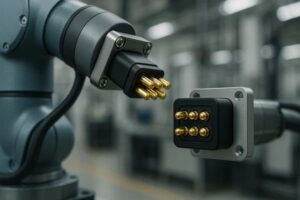
Custom medical magnetic connectors (powered by precision pogo pin technology) are answering this call. By acting as a "neural hub," these connectors ensure that intent-recognition signals and motor-drive power flow uninterrupted, even during vigorous physical therapy sessions.
Technical Analysis: Extreme Requirements for Wearable Exoskeletons
To safely bridge the gap between human biomechanics and robotic actuators, powered exoskeletons require interconnects that meet strict medical engineering standards:
1. Signal Integrity for Intent Recognition (EMG)
Electromyography (EMG) signals, measured in microvolts, are the basis for a robot "understanding" a patient’s movement intention. Medical magnetic connectors maintain an ultra-stable contact resistance of ≤ 30mΩ. This heavy gold-plated contact reduces signal noise by over 40%, providing a clean, distortion-free data stream for the real-time motion control units.
2. Dynamic Stress Tolerance and Misalignment Compensation
Human joint motion creates continuous, unpredictable alternating loads. Specialized magnetic pogo pins utilize advanced magnetic-controlled adsorption to provide ± 0.5mm misalignment compensation, maintaining contact during dynamic stretching. Innovative dual-spring structures allow these pins to exceed 100,000 to 1,000,000 cycles, far outlasting traditional clinical plugs.
3. Sterile Biocompatibility and IP68 Sealing
Because these devices operate in clinical settings and frequently contact patient skin, the connectors must comply with ISO 10993 standards. Medical-grade coatings (such as Palladium-Nickel) and project-specific sealing and insert-molding allow the magnetic interfaces to withstand repeated wiping with alcohol and chlorine-based disinfectants without corroding or harboring pathogens.
4. Multi-Joint Coordinated Transmission
Exoskeletons must synchronize hip, knee, and ankle joints instantly. Custom 4-to-12 pin magnetic arrays support the parallel transmission of position, torque, and EMG data, utilizing ground isolation pins to prevent heavy motor power noise from contaminating delicate sensor readings.
Application Cases: Driving Human-Machine Interaction
- Series Elastic Actuator (SEA) Modules: SEA units provide compliant, safe human-robot interaction. Ultra-thin (0.4mm pitch) medical magnetic connectors allow motor drive boards to communicate with torque sensors in confined joint spaces, reducing energy loss.
- EMG and IMU Sensing Arrays: Adaptive exoskeletons fuse muscle activity (EMG) and motion data (IMU). Magnetic interfaces ensure high-fidelity transmission of these weak signals, which is critical for the software to calculate real-time assistance requirements.
- Modular Battery Quick-Change: High-current magnetic interfaces have reduced battery replacement time from 3 minutes to just 15 seconds, significantly improving equipment throughput and patient turnover in busy rehabilitation clinics.
Empirical Data: User Value & Clinical ROI
Replacing traditional push-pull connectors with self-aligning magnetic interfaces transforms the rehabilitation experience for both therapists and patients:
| Clinical Metric | Traditional Wired Exoskeleton | Medical Magnetic Connectors |
|---|---|---|
| Preparation Efficiency | 10–15 minutes (Manual cable routing) | 2–3 minutes (Magnetic auto-alignment) |
| Cleaning & Sterilization | Difficult (Fluid traps in deep cavities) | Instant (Flat, IP68 wipeable surface) |
| Maintenance & Lifecycle | High wear, frequent pin bending | Million-cycle durability (40% cost reduction) |
Future Outlook: Soft Robotics and AI Integration
The future of rehabilitation lies in flexible exoskeletons and soft robots (exosuits). This will require stretchable magnetic connectors that maintain signal stability even as the "suit" deforms to match human muscle movement. Furthermore, self-healing coatings and 5G+AIoT synchronization will allow for personalized, home-based rehabilitation where the exoskeleton adjusts its assistance levels based on cloud-processed neural data seamlessly transmitted through magnetic nodes.
Conclusion: Precision Connection Enabling Life Reconstruction
The true value of a rehabilitation exoskeleton is found in the moment a patient takes their first independent step after injury. At the heart of that movement are medical-grade magnetic connectors.
By bridging the gap between sophisticated drive systems and wearable comfort, these connectors are not just transmitting power—they are facilitating the standing, walking, and life reconstruction of patients worldwide. If you are developing next-generation medical wearables or robotic exoskeletons, our engineering team at CTP is ready to assist. Visit our Contact Page to discuss custom medical magnetic solutions.
CTP ENGINEERING PATHS
Choose the right path for your project
Move from application requirements to a connector pair, a data-capable cable assembly, or a charging cable configuration. Final specifications are confirmed against an approved drawing and project validation plan.
Magnetic Connectors
Connector geometry, pin layout, mechanical integration and OEM/ODM review.
Engineering overview → 02Magnetic Data Cables
Power and signal allocation, cable exit, interface selection and assembly review.
Cable engineering → 03Magnetic Charging Cables
Browse the complete cable catalog and shortlist a starting structure for customization.
View cable catalog →